General information
PolyPeptide is a focused CDMO, specializing in the development and manufacturing of synthetic peptides used as active pharmaceutical ingredients (API) or intermediates in therapeutic products. Our mission is to help customers to develop products, secure regulatory approval, and successfully launch and commercialize their products by combining cGMP-compliant manufacturing practices with efficient and sustainable technologies.
As a CDMO serving pharmaceutical and biotech companies, PolyPeptide must adhere to stringent product quality requirements and regulations to protect the safety of patients. The Group is committed to driving sustainability by embedding core principles of sustainable business practices, ethical conduct, and regulatory compliance into its operations and Enterprise Risk Management (ERM) framework. At PolyPeptide, material sustainability topics are anchored in our corporate strategy and daily operations, reflecting our commitment to long-term value creation and alignment with evolving regulatory requirements.
PolyPeptide’s strategy builds on its multi-site network to strengthen its foundations and competitive advantages, with innovation in green chemistry playing an increasingly important role in sustainable peptide drug manufacturing.
PolyPeptide’s global footprint enables us to drive meaningful change across the pharmaceutical value chain through responsible practices and collaboration with partners worldwide. Through the Group’s green chemistry agenda, PolyPeptide aims to improve environmental sustainability by reducing and optimizing the use of hazardous solvents across its processes. By prioritizing sustainability in our innovation, development and operational efforts in areas where we believe we can have the greatest influence, we aim to contribute to a more sustainable future.
In 2025, PolyPeptide further fortified its climate transition plan by including near-term, science-based greenhouse gas (GHG) reduction targets for Scopes 1, 2, and 3, as approved by the Science Based Targets initiative (SBTi). To reinforce this commitment and align with evolving expectations of business partners and investors, PolyPeptide is voluntarily reporting in reference to the EU Corporate Sustainability Reporting Directive (CSRD) and the European Sustainability Reporting Standards (ESRS)1 as well as in accordance with the Taskforce on Climate-related Financial Disclosure (TCFD) framework.
For further information regarding PolyPeptide’s strategy, market, and business model, see section Strategy.
The Group participates in the Carbon Disclosure program (CDP), scoring a “B” rating in 2025 (2024: B). This is complemented by the EcoVadis ratings, where PolyPeptide received an “Advanced” rating for its carbon management program in 2025 and a “Silver” rating for its sustainability program, a recognition awarded to the Top 15% of companies assessed by EcoVadis in the 12 months prior to the medal issue date2.
Since January 2026, all manufacturing sites are certified according to ISO45001:2018 Occupational health & safety, ISO14001:2015 Environmental management and ISO27001:2022 Information Security.

EcoVadis recognition page: https://recognition.ecovadis.com/m2avg0A0X0WP6JOkVsRCEg
Basis for preparation
This Sustainability Report covers the period 1 January – 31 December 2025 and is prepared in accordance with art. 964b of the Swiss Code of Obligations concerning transparency on non-financial matters as well as the Swiss Ordinance on Climate Disclosures (see sections Index of disclosure requirements in accordance with art. 964b Swiss Code of Obligations and Climate disclosures in accordance with art. 964b Swiss Code of Obligations and TCFD recommendations).
Furthermore, the Sustainability Report has been prepared in reference to ESRS for sustainability matters identified as material for the Group (see sections ESRS Content index of material disclosures)1.
In 2024, PolyPeptide conducted a Double Materiality Assessment (DMA) in reference to ESRS to address material impacts, risks and opportunities (IROs) across its own operations as well as its upstream and downstream value chain.
All direct and indirect subsidiaries that PolyPeptide Group AG consolidates fall under the scope of this Sustainability Report 2025 (for a detailed overview of PolyPeptide’s consolidated subsidiaries, see section 1.1.3 Non-listed companies belonging to PolyPeptide of the Corporate Governance Report 2025 and note 11 Investments in subsidiaries of the consolidated financial statements in the Financial Report 2025).
Disclosures in relation to specific circumstances
As part of the transition to reporting in reference to ESRS, 2025 serves as the base year for certain metrics reported for the first time. Scope 1, 2 and 3 emissions continue to rely on 2022 and 2023 as base year data used for the transition plan, as business activities during these years were broadly typical and representative. There were no significant financial or non-financial anomalies compared to previous years. Operational volumes and key performance indicators remained within normal ranges and reflected standard business activity. Comparative information for environmental metrics from preceding years is included where relevant, available and appropriate to support meaningful interpretation. Unless otherwise noted, 2025 serves as the base year for social and governance disclosures, and comparative information is not included in the first year of reporting where methodologies are newly introduced or updated. Comparative analyses for these metrics will be incorporated in future reports once data availability and methodological consistency allow.
Unless otherwise stated, PolyPeptide applies the ESRS definitions for short-, medium-, and long-term time horizons, referring to short-term as up to one year, medium-term as from one to five years and long-term as more than five years.
Data collection and estimation
We prioritize the use of primary data from our operations whenever practicable. For certain indicators, particularly those related to our value chain, we may apply proxies, estimates or extrapolated figures where direct measurement is not yet feasible or full‑year data are unavailable. All estimates are derived from documented judgments and assumptions, informed by historical performance, industry benchmarks and comparable datasets. Extrapolation is used only when underlying patterns are assessed as stable over time.
Quality and consistency checks are conducted across all reporting entities and are being progressively embedded into our internal control environment. In 2025, PolyPeptide implemented an integrated ESRS and carbon accounting reporting platform to improve efficiency, transparency, traceability, and scalability in sustainability reporting while reducing manual processes and external dependencies. Key advantages include automated data collection and aggregation, reliable data quality and governance through workflows and audit trails, and compliance with evolving regulatory requirements.
Despite these efforts, inherent limitations in data availability, estimation and consolidation mean that some sustainability information may carry uncertainties, and minor inaccuracies may remain undetected even with robust processes and controls in place. Where applicable, applied methodologies and assumptions are outlined in the sections Accounting policies.
Assessment of effectiveness of measures across material topics
For each material topic, PolyPeptide defines, implements and discloses specific actions in line with its policies and identified risks and negative impacts. The effectiveness of these actions is assessed through a combination of defined metrics, internal controls and regular monitoring processes. Progress is evaluated against quantitative and qualitative targets, supported by trend analyses, audit results, incident reporting and relevant stakeholder feedback.
Governance
At PolyPeptide, the Board of Directors (Board) is responsible for the overall direction of the Group and oversight of management, including the Group’s growth strategy that recognizes the importance of sustainability as part of its strategic foundation. The Board also oversees climate-related risks and opportunities. It supervises the identification of material sustainability topics and approves the Annual Report, including this Sustainability Report.
The governance of the Group’s strategy, including its climate change transition plan and GHG reduction targets, ensures oversight and effective implementation. The Board oversees alignment between financial, business, and sustainability interests, regularly monitors trends and regulations, and integrates climate-related considerations into strategic planning, risk management, and performance objectives.
PolyPeptide assigns specific sustainability topics to Board committees to ensure that oversight is embedded into governance and aligned with expertise. Oversight of sustainability matters, including the setting and monitoring of targets, is thematically assigned to the Audit and Risk Committee (ARC) for risk, compliance and ethic topics, the Innovation and Technology Committee (ITC) for technical transformation of sustainability including decarbonization, innovation, safer production, and efficient resource use) and the Remuneration and Nomination Committee (RNC) for the people dimension of sustainability, including safety, culture, capability, fairness and remuneration. See also the table Assigned oversight and responsibilities for material sustainability topics below. For details on the responsibilities and composition of these committees, refer to section 3.5.3 Working Methods of the Committees in the Corporate Governance Report 2025. While PolyPeptide has not adopted targets on all identified impacts, risks and opportunities, the effectiveness of implemented policies and actions is tracked by the responsible functions. The overall responsibility for tracking and ensuring effectiveness and progress rests with the Executive Committee.
The climate strategy is supervised by the ITC and the implementation is coordinated by the cross-functional Green Steering Committee, which also oversees the Group’s Green Master Plan. This plan includes initiatives that address both the optimized use of chemical substances, i.e., the green chemistry agenda and the Group’s carbon footprint.
The Director Global EHS, a member of the Green Steering Committee, develops and oversees the implementation of the transition plan, oversees GHG emissions assessments, and monitors progress toward science-based targets. He ensures clear reporting mechanisms for tracking and managing climate-related matters. The Chief Manufacturing and Supply Chain Officer as well as site directors are responsible for executing the transition plan at manufacturing sites. The transition plan, approved by the Board of Directors, is reviewed every five years, with annual assessments for updates. The Director Global EHS coordinates the review process and presents the outcomes to the relevant governance bodies.
Internal reporting and review of the climate strategy and transition plan is structured as follows:
- Board of Directors: annually
- ITC: twice per year
- Green Steering Committee: quarterly
- Sustainability Steering Committee: periodically
PolyPeptide sustainability governance
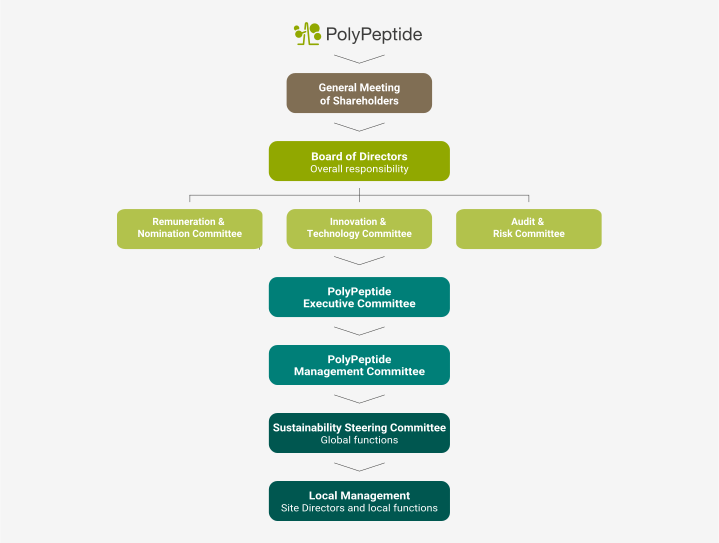
Sustainability Steering Committee coordinates implementation
The responsibility and authority for carrying out operational activities of the Group are delegated to the Executive Committee. This includes the implementation of the Group’s sustainability activities as an integrated part of its strategy and business plans. The Executive Committee receives support from the PolyPeptide Management Committee and the Sustainability Steering Committee1, where relevant global functions are represented. These functions have been assigned responsibility for material sustainability topics, as set out in the table below, to make sure they are adequately reflected within the functional plans and, with the support of local management, in the Group’s day-to-day operations. Within this governance framework, regular reporting on sustainability topics is ensured.
Assigned oversight and responsibilities for material sustainability topics
|
Material sustainability topics |
Board Committee oversight |
Functional responsibility (as member of Sustainability Steering Committee) |
|
|
Climate change, Pollution, Resource use and circular economy (E1, E2, E5) |
Innovation and Technology Committee (ITC) |
• |
Director Global EHS |
|
|
|
• |
Director Global Innovation & Technology |
|
Own workforce (S1) |
Remuneration and Nomination Committee (RNC) |
• |
Chief Human Resources Officer |
|
|
|
• |
Director Global EHS |
|
Workers in the value chain (S2) |
Audit and Risk Committee (ARC) |
• |
Director Global Procurement |
|
Access to safe and effective products (S4) |
Innovation and Technology Committee (ITC) |
• |
Chief Manufacturing and Supply Chain Officer |
|
|
|
• |
Director Global Quality, Development & Regulatory Affairs |
|
Business conduct (G1) |
Audit and Risk Committee (ARC) |
• |
Chief Legal Officer |
|
|
|
• |
Director Global IS / IT |
During 2025, a new role of Global Head of Sustainability was created as part of the Legal and Compliance department with responsibility for coordinating sustainability initiatives for PolyPeptide as chair of the Sustainability Steering Committee. Working closely across functions to continue driving the Group’s sustainability efforts, this role also ensures compliance with relevant regulations and standards, including reporting and disclosure requirements.
As part of the Group’s ERM framework, the Group evaluates the risks and opportunities in relation to the material sustainability topics (including climate change), with relevant developments reported to the Board of Directors on an annual basis (see section 3.7.3 Enterprise Risk Management Framework of the Corporate Governance Report 2025). The Board holds ultimate responsibility for risk management, while the PolyPeptide Management Committee (together with the ARC) is responsible for ensuring that the operation of the ERM Framework is sound, including risk management of significant risks through the monitoring of specified actions.
In addition, PolyPeptide’s reporting and disclosure of sustainability topics in this Sustainability Report 2025 is subject to an independent practitioner’s limited assurance report by BDO AG (Zurich).
Guidelines and policies
PolyPeptide is subject to comprehensive regulations, including current Good Manufacturing Practices (GMP), to ensure the quality of its services and products. The Group runs a network of six manufacturing sites in Europe (Belgium, France and Sweden), the United States of America, and India, with each of the sites subject to regular inspections by regulatory authorities and audits by customers. All sites are GMP certified, demonstrating suitable processes, methods, facilities, and controls.
The Group maintains a Quality Management System with policies and procedures designed to ensure compliance with applicable standards. For GMP-related activities, these policies and procedures reflect customers’ obligation to use drug substances and intermediates manufactured in compliance with GMP to ensure patient safety, while also addressing requirements applicable to non-GMP operations. This includes adherence to applicable guidelines, in particular those from the International Council for Harmonization of Technical Requirements for Pharmaceuticals for Human Use.
For each manufacturing site, the Group maintains an internal Environment, Health and Safety (EHS) policy, structured to promote adherence to applicable EHS standards and regulations. Moreover, PolyPeptide commits to the Responsible Care initiative and implements an EHS management system certified ISO14001: 2015 and ISO45001:2018 for all manufacturing sites.
It has further developed policies and procedures that address, among other things, due diligence and risk management principles as well as the protection of human rights. The Group has issued the following policies that are available on its corporate website:
- Code of Business Conduct and Ethics,
- Supplier Code of Conduct,
- Global Anti-Corruption and Anti-Bribery Policy,
- Global Supply Chain Policy on Child Labor, and
- Whistleblower Policy
The policies are underpinned by fundamental international conventions and guidelines, including, where applicable, International Labor Organization Conventions, the United Nations Universal Declaration of Human Rights, the United Nations Global Compact principles, the Organization for Economic Cooperation and Development (OECD) Guidance for Responsible Business, industry standards, and other relevant statutory requirements. In 2025, PolyPeptide advanced its commitment to sustainable and responsible business practices by becoming a participant in the United Nations Global Compact and aligning with its principles-based approach.
Furthermore, PolyPeptide has implemented various internal policies to further support compliance and ethical business practices (e.g., Insider Dealing and Market Manipulation Policy, Disclosure Policy, Global Sanctions and Export Control Compliance Policy and Procedure, Risk Assessment and Reporting Procedure, and Enterprise Risk Management Policy).
Due diligence across all material topics
Sustainability due diligence is embedded in PolyPeptide’s governance, strategy, and risk management framework. The Board of Directors has overall responsibility for the approval of the Group’s sustainability‑related policies and for the oversight of material sustainability topics and risks, including climate‑related risks and the associated due‑diligence processes. The Executive Committee is responsible for the operational implementation of these policies and due diligence processes as an integral part of the Group’s strategy and business plans.
PolyPeptide has adopted Group‑wide policies covering environmental matters, social and employee-related issues, respect for human rights, and business ethics, including anti‑corruption (see section Guidelines and policies). These policies set out the principles governing the Group’s conduct in its own operations and, where relevant and proportionate, in its business relationships.
A risk‑based due diligence process is applied for all material sustainability topics. Risks, impacts and opportunities are identified and assessed primarily through the Group’s double materiality assessment (see section Double materiality assessment) and the ERM framework, and are complemented by compliance processes, site‑level assessments, EHS management systems, human‑rights assessments, and supplier due diligence, including audits where appropriate. Stakeholder engagement supports risk identification and prioritization.
Identified risks and adverse impacts are addressed through policies, procedures and appropriate mitigating measures, including corrective actions.
The effectiveness of due diligence measures is monitored through internal controls, audits, performance indicators and regular reporting within the ERM framework. Concerns can be raised confidentially and even anonymously, if desired, through PolyPeptide’s whistleblower hotlines available to employees and external stakeholders.
PolyPeptide’s sustainability due diligence approach is reflected throughout this Sustainability Report, including in the disclosures on material impacts, risks and opportunities, related policies, actions, targets and metrics.
Strategy and remuneration
Details of PolyPeptide’s strategy are highlighted in the Management Report 2025. To support the implementation of its strategy and operational plans as well as for executive compensation purposes, PolyPeptide maintains a Global Balanced Scorecard (GBSC). The GBSC consists of financial targets as well as quantitative goals for non-financial criteria, including sustainability-related aspects. In 2025, PolyPeptide incorporated Scope 1 and Scope 2 GHG emissions reduction targets, committed under its transition plan, into its GBSC, engaging selected staff participating in the initiative.
Through the GBSC, sustainability aspects are also incorporated in the variable compensation of the Executive Committee, as described in section 5.1.3.2 2025 STIP of the Remuneration Report 2025.
Supporting the UN Sustainable Development Goals
PolyPeptide supports the United Nations 2030 Agenda for Sustainable Development and recognizes the 17 Sustainable Development Goals (SDGs) as a vital global framework for fostering peace, prosperity, and environmental stewardship.
PolyPeptide focuses its contributions on those most aligned with its material topics within Environment, Own workforce, Workers in the value chain, Access to safe and effective products, and Business conduct.
|
Material topics |
Relevant SDGs 1 |
Relevant underlying targets |
PolyPeptide contribution |
|
|
Access to safe and effective products (S4) |
|
Ensure healthy lives and promote well-being for all at all ages |
3.8 Contribute to providing access to quality health care services, as well as to safe, effective, quality, and affordable essential medicines and vaccines. |
PolyPeptide’s core business is the development and manufacturing of peptide-based APIs, supporting drug innovation and ensuring a reliable supply of high-quality materials for the pharmaceutical and biotech industries. This indirectly contributes to patient safety and access to essential medicines, allowing us to contribute to the health of millions of patients. |
|
Pollution, Resource use and circular economy (E2, E5) |
|
Build resilient infrastructure, promote sustainable industrialization, and foster innovation |
9.4 Upgrade infrastructure, technologies, and processes for sustainable and efficient use of resources. |
PolyPeptide invests in innovative process development, green chemistry, and advanced manufacturing infrastructure to support sustainable growth. The Group applies green chemistry principles to reduce, recycle and recover hazardous substances, and to develop safer, more sustainable production processes. |
|
|
Ensure sustainable consumption and production patterns |
12.4 Ensure management of chemicals and all wastes throughout their life cycle. 12.5 Reduce waste generation through prevention, reduction, recycling, and reuse. |
PolyPeptide is committed to reducing the environmental impact of its operations by improving how solvents are managed across all sites. To address this, we have launched several programs focused on down-cycling solvent waste and, wherever feasible, recovering solvents for reuse in production processes. |
|
|
Climate change (E1) |
|
Take action to combat climate change and its impacts |
13.2 Integrate climate change measures into policies, strategies, and planning. |
PolyPeptide has set science-based targets to reduce absolute Scope 1 and 2 GHG emissions by 42% by 2030 (from 2023 base year), and Scope 3 emissions by 61.1% per EUR value added by 2033 (from 2022 base year). The Group commits to transitioning to 100% renewable electricity by 2029 and electrifying its vehicle fleet. PolyPeptide conducts regular climate scenario analyses, integrates climate risks into financial planning, and participates in CDP and EcoVadis climate programs. 45% of suppliers (by spend) are targeted to have science-based targets by 2029. |
|
Workers in the value chain (S2) |
|
Promote inclusive and sustainable economic growth, employment, and decent work |
8.7 Secure the prohibition and contribute to the elimination of child labor. |
PolyPeptide’s Supplier Code of Conduct enforces fair labor practices and human rights throughout its value chain. PolyPeptide's supply chain risk assessment includes due diligence on child labor and conflict minerals, and the Group aims to report transparently on compliance and ethics. |
|
Own workforce (S1) |
|
Achieve gender equality and empower women |
5.5 Ensure participation and equal opportunities for leadership at all levels of decision making. |
PolyPeptide’s Code of Business Conduct and Ethics prohibits harassment, bullying, and discrimination, and promotes diversity, equity, and inclusion. Equal employment opportunities and respect for human rights are emphasized. The Group tracks gender diversity in its workforce, including at management levels, and reports on gender splits in production and other functions. |
|
|
Promote inclusive and sustainable economic growth, employment, and decent work |
8.5 Achieve productive employment, decent work, and equal pay for work of equal value. |
PolyPeptide offers job opportunities across its international manufacturing network, with ongoing training and development for employees. The Group upholds fair, inclusive, and respectful workplace practices, with a zero-tolerance policy for discrimination and firm commitments to labor rights. PolyPeptide is committed to building a strong safety culture across all its sites, with the ambition to achieve zero lost-time injuries (LTI) and continuously lower the severity rate year over year to ensure a safer and healthier workplace for all employees. |
|
|
Business conduct (G1) |
|
Promote just, peaceful and inclusive societies, and build effective, accountable, and inclusive institutions |
16.5 Contribute to the reduction of corruption and bribery. |
PolyPeptide maintains a robust compliance framework, including a Code of Business Conduct and Ethics, Supplier Code of Conduct, Global Anti-Corruption and Anti-Bribery Policy, and whistleblower programs. |




Stakeholder engagement
PolyPeptide maintains an open dialog with internal and external stakeholders and is a member of various pharmaceutical and industry associations as well as the local and broader business community. Associations may serve a variety of purposes, such as exchanging best practice, advancing innovation and sustainability, and fostering collaboration1.
|
Stakeholder group |
Examples of stakeholder engagement |
|
Impact on strategy and business model |
|
Customers |
Customer feedback |
|
Feedback can drive innovation and improvement of existing business practices. Customer insights can influence pricing strategies and operational processes. |
|
Cultivating a long-term trusted partnership |
|||
|
Mantra of "Start here – stay here" and strong customer-centric perspective |
|||
|
Shareholders |
Consistent implementation of strategy and operational plans |
|
Expectations for transparent reporting and consistent execution can push for a robust governance and risk management framework and influence capital allocation decisions. |
|
Transparent, integrated corporate reporting |
|||
|
Open dialog and communications through different channels |
|||
|
Employees |
Collaborative, diverse, and inclusive international working environment |
|
Engagement and diversity initiatives play a role in shaping PolyPeptide's talent acquisition and retention strategies. A focus on health and safety can drive operational improvements and reinforce compliance priorities. At the same time, a collaborative culture fosters innovation and agile working models. |
|
Fostering dialog via townhalls, internal news, and employee events |
|||
|
Global employee engagement survey |
|||
|
Regular dialog to discuss individual development plans |
|||
|
Focus on employee health and safety |
|||
|
Active dialog and collaboration with applicable unions and freely chosen employee representatives |
|||
|
Suppliers |
Long-term collaboration |
|
By fostering long-term partnerships and enforcing its Supplier Code of Conduct, PolyPeptide ensures that its supply chain strategy supports sustainability and responsible sourcing. |
|
Supplier Code of Conduct |
|||
|
Industry associations |
Collaboration, also to advance innovation and sustainability |
|
Joint efforts to advance innovation and sustainability can shape innovation priorities and compliance standards. |
|
Communities |
Sponsoring of local activities |
|
By fostering civic engagement and educational partnerships, PolyPeptide can enhance its employer branding and secure its social license to operate. Partnerships with universities can create talent pipelines, reducing recruitment costs. |
|
Charitable contributions and partnerships for civic engagement |
|||
|
Engagement with universities, educational institutions, students, and graduates |
|||
|
Collaboration with communities on employment and training opportunities for job seekers |
Double materiality assessment
As part of the development of our sustainability strategy and in reference to the CSRD and ESRS, PolyPeptide conducted a DMA in 2024. The DMA identifies material sustainability topics by evaluating PolyPeptide’s material impacts on people and environment (impact materiality) and the material effects of sustainability matters on PolyPeptide’s development, performance and position (financial materiality) of our own operations as well as our upstream and downstream value chain. In this context, the financial effects of sustainability topics were mainly qualitatively assessed. Given the evolving understanding of related impacts, risks, and opportunities, potential financial effects, while assessed in accordance with the ERM framework, are not yet quantified or disclosed across all topics at this stage.
Process overview:
1. Project initialization and context analysis: PolyPeptide mapped its business model, value chain, and key stakeholder groups to establish the context for materiality assessment.
2. Initial assessment of ESRS Topics: The Group reviewed 94 ESRS sub-topics, assessing their impacts, risks and opportunities using the criteria scale, scope, likelihood, and difficulty of remediation for impacts, risks, and opportunities. Internal subject matter experts refined these assessments.
3. Shortlisting and aggregation: After descoping non-material topics, 25 sub-topics were consolidated into overarching material topics, which were grouped into seven ESRS standards, benchmarked against peers and regulatory standards.
4. Stakeholder and management surveys: PolyPeptide engaged internal and external stakeholders, as well as management, through online surveys to assess the significance of shortlisted topics from both impact and financial perspectives.
5. Validation and finalization: A validation workshop with senior management and external advisors was held to review and confirm the material topics, ensuring the selected topics and related impacts, risks and opportunities accurately reflect PolyPeptide’s context and stakeholder expectations.
As noted above, stakeholder engagement was an integral part of the DMA and PolyPeptide conducted an online survey to assess the relevance and significance of shortlisted sustainability topics. The survey involved over 200 customers, shareholders, industry associations, communities, suppliers, and employees, ensuring that PolyPeptide’s materiality assessment was informed by a broad range of perspectives and aligned with stakeholder expectations and business priorities.
Participants were asked to evaluate potential negative and positive impacts of PolyPeptide’s activities on people and the environment for each material topic, using a standardized scale (1–6), and could also suggest additional relevant topics. A separate management survey targeted PolyPeptide’s Management Committee and the Sustainability Steering Committee to assess the magnitude and likelihood of risks and opportunities for each material topic from a business perspective, using the same standardized scale (1–6).
Survey results were combined with subject matter expert assessments to calculate materiality scores for each topic, informing the relative materiality among the topics.
The Board of Directors approved the final list of material topics, which defines the material sustainability topics highlighted in this Sustainability Report.
The resulting material topics for PolyPeptide are:
- E1 Climate change
- E2 Pollution
- E5 Resource use and circular economy
- S1 Own workforce
- S2 Workers in the value chain
- S4 Access to safe and effective products1
- G1 Business conduct
For the ESRS content index of material disclosures, see the Appendix to this Sustainability Report.