3Board of Directors
The Board of Directors is responsible for PolyPeptide’s overall direction and oversight of management, and holds the ultimate decision-making authority, with the exception of matters reserved for shareholders.
We believe that the composition of our Board of Directors should reflect PolyPeptide’s objectives, strategic requirements, geographical reach and its culture. The Board of Directors should further be diverse in terms of age, gender, nationality, geographical / regional background and business experience.
In furtherance of this, the Board of Directors has determined a wide range of skills to ensure that all members are well qualified, committed and willing to devote the necessary time and effort to effectively perform their responsibilities. Based on the defined set of competencies, the Board members were asked to identify their key skills highlighted by their educational and professional background and personal achievements, as illustrated in the chart below.
Board skills distribution(as of 31 December 2025)
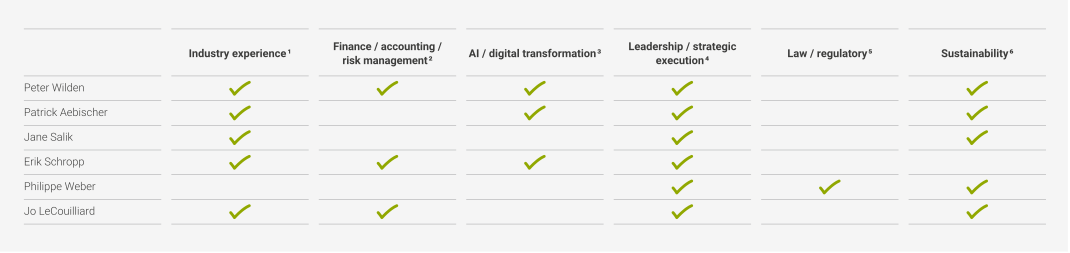
The RNC regularly assesses the set of competencies as well as each Director’s contributions to ensure that an appropriate mix of skills, expertise and diversity is represented on the Board of Directors and its Committees. In addition, the RNC, together with the Board of Directors, actively considers the key skills illustrated above, as well as gender diversity, in succession planning of the Board of Directors as well as of the Executive Committee.
3.1Members of the Board of Directors
During the reporting period, the number of members of the Board of Directors remained at six (6). Five (5) Directors in office as of 1 January 2025 stood for re-election at the general meeting 2025 held on 9 April 2025 (“AGM 2025”) and were approved by the shareholders. Beat In-Albon was elected as a member of the Board of Directors at the EGM 2021 and decided not to stand for re-election at the AGM 2025.7 Furthermore, Jo LeCouilliard was elected as a new member of the Board of Directors at the AGM 2025. Thus, as of 31 December 2025, the Board consisted of six (6) non-executive Directors (including the Chair and the Lead Independent Director), five (5) of which are independent, as outlined below:
|
Name |
Position |
First election |
End of term |
|
|
|
|
|
|
Peter Wilden |
Chair, Non-executive and Independent 1, 2 |
2021 |
AGM 2026 |
|
Patrick Aebischer |
Vice-Chair, Non-executive and Lead Independent Director 2, 3 |
2021 |
AGM 2026 |
|
Jane Salik |
Member, Non-executive and Independent 2 |
2021 |
AGM 2026 |
|
Erik Schropp |
Member, Non-executive 4 |
2021 |
AGM 2026 |
|
Philippe Weber |
Member, Non-executive and Independent 2, 5 |
2021 |
AGM 2026 |
|
Jo LeCouilliard |
Member, Non-executive and Independent 2, 6 |
2025 |
AGM 2026 |
PolyPeptide believes that the composition of its Board of Directors and Committees with regard to independence and competences fairly reflects and balances the interests of its shareholders and other stakeholders.
Set out below is a short description of the business experience, education and activities of each Director.

Peter Wilden
Chair since 2021Independent8; Non-executive9
Professional background
Prior positions at PolyPeptide
- Group Executive Chair (30 January 2023–30 September 2023)
Outside mandates at listed companies
- None
Outside mandates at non-listed companies
- None
Outside mandates at non-profit organizations
- Member of the board of directors of the Suisse Polar Foundation, Switzerland (since 2018)
- Chair of the board of directors of Project HOPE Suisse International Foundation, Switzerland (since 2015)
- Member / Vice-Chair of the board of directors of Project HOPE, US (since 2012)
Former outside activities and functions
- Member of the board of directors of Ferring International Center SA, Switzerland (2002–December 2024, Executive Chair 2002–December 2023)
- Member / Chair of the Audit Committee / Vice-Chair of the board of directors of Lonza Group AG, Switzerland (2004–2014)
- Executive Vice-President and CFO of Ferring Pharmaceuticals, Switzerland (2000–2017)
Education
- PhD in Economics, University of Kiel, Germany (1991)
- MBA in Industrial Economics, University of Kiel, Germany (1986)
- Education Tax Inspector at the German Inland Revenue Service, Germany (1977–1980)

Patrick Aebischer
Vice-Chair and Lead Independent Director since 202110Non-executive
Professional background
Prior positions at PolyPeptide
- None
Outside mandates at listed companies
- Member of the board of directors of Nestlé SA, Switzerland (since 2015)
Outside mandates at non-listed companies
- Managing Partner at Limani Partners SA, Switzerland (since 2025)
- Member of the board of directors of Swiss Vaccine SA, Switzerland (since 2022)
- Chair of the board of directors of Vandria SA, Switzerland (since 2021)
- Chair of the board of directors of Amazentis SA, Switzerland (since 2007)
Outside mandates at non-profit organizations
- Member of the board of directors of Fondation “Geneva Science & Diplomacy Anticipator”, Switzerland (since 2019)
- Member of the board of directors of Fondation du domaine de Villette, Switzerland (since 2018)
- Member of the board of directors of Fondation Defitech, Switzerland (since 2017)
- Chair of the board of directors of Swiss Polar Foundation, Switzerland (since 2016)
- Member of the board of directors of Fondation Claude Nobs, Switzerland (since 2015)
- Member of the board of directors of Fondation du Festival de Verbier, Switzerland (since 2015)
Former outside activities and functions
- Senior Partner of NanoDimension Management Limited, Cayman Islands (2017–2025)
- Member of the board of directors of Logitech SA, Switzerland (2016–2024)
- Chair of the board of directors of the Novartis Venture Fund, Switzerland (2014–2023)
- Member of the board of directors of Lonza Group AG, Switzerland (2008–2020)
- Professor of Neurosciences, Swiss Federal Institute of Technology Lausanne (EPFL), Switzerland (2000–2019)
- President of the Swiss Federal Institute of Technology Lausanne (EPFL), Switzerland (2000–2016)
Education
- Dr. in Medicine, University of Geneva, Switzerland (1983)
- MD, University of Geneva, Switzerland (1980)

Erik Schropp
Member since 2021Non-executive
Professional background
Prior positions at PolyPeptide
- Member of the board of directors of PolyPeptide Laboratories Holding B.V., The Netherlands, and PolyPeptide Laboratories Holding (PPL) AB, Sweden (2017–2021)
Outside mandates at listed companies
- None
Outside mandates at non-listed companies
- CEO of Esperante Investments Group (since 2020) (including serving as a member of the board of directors of Draupnir Corporation B.V., The Netherlands (since 2022) and Draupnir Holding B.V., The Netherlands (since 2008)11 and of the following strategic business units: (i) SEVER Life Sciences B.V., The Netherlands (since 2019), including serving as a member of the board of directors of two subsidiary companies; (ii) Esperante Ventures B.V., The Netherlands (since 2008); (iii) Svar Life Science AB, Sweden (since 2008), including serving as a member of the board of directors of two subsidiary companies)
- Member of the board of directors of Haydn Holding AB, Sweden (since 2012) (including serving as a member of the board of directors at six subsidiary companies)
- Member of the board of directors of Ferring Foundation B.V., The Netherlands (since 2008) (including serving as a member of the board of directors of one subsidiary entity)
Outside mandates at non-profit organizations
- Member of the board of directors, Stichting Det Paulsen Legaat, The Netherlands (since 2023)
- Member of the board of directors, Stichting Vrienden van Megara, The Netherlands (since 2022)
Former outside activities and functions
- Group Financial Officer, C&P Investors Group (presently: Esperante Investments Group), The Netherlands (2008–2020)
Education
- Master’s degree in Economics & Tax, Erasmus University, Rotterdam, The Netherlands (1988)

Jane Salik
Member since 2021Independent12; Non-executive
Professional background
Prior positions at PolyPeptide
- Group CEO (2006–April 2021) and Executive Committee member (2006–August 2021)
- President, PolyPeptide Laboratories Inc., US (1996–2006)
- Member of the board of directors of PolyPeptide Laboratories Holding B.V., The Netherlands, as well as certain of its direct and indirect global subsidiaries (2003–2021)
Outside mandates at listed companies
- None
Outside mandates at non-listed companies
- None
Outside mandates at non-profit organizations
- None
Former outside activities and functions
- Vice President of Sales and Marketing, Bachem California, US (1986–1996)
- Technical services biochemist, product manager and marketing manager, Boehringer Mannheim, US (1980–1986)
Education
- PhD in Molecular and Cellular Biology, SUNY Stony Brook, US (1980)
- B.A. in Biology, Lafayette College, US (1975)

Philippe Weber
Member since 2021Independent13; Non-executive
Professional background
Prior positions at PolyPeptide
- None
Outside mandates at listed companies
- Vice-Chair of the board of directors of Leonteq AG, Switzerland, and Leonteq Securities AG, Switzerland (both since 2020)
- Member of the board of directors of Medacta Group AG, Switzerland (since 2019)
- Member of the board of directors of EDAG Engineering Group AG, Switzerland (since 2015)
Outside mandates at non-listed companies
- Member of the board of directors of NorthStar Holding AG, Switzerland (since 2018)
- Member of the board of directors of Banca del Ceresio SA, Switzerland (since 2017)
- Member of the board of directors of Newron Suisse SA, Switzerland (since 2007)
- Partner at Niederer Kraft Frey AG, Switzerland (since 2002)
- Company Secretary of CLS Group Holdings AG, Switzerland (since 2002)
Outside mandates at non-profit organizations
- None
Former outside activities and functions
- Director of Robert Aebi AG, Switzerland (2004–2017)
Education
- PhD in law (summa cum laude), University of Zurich, Switzerland (1995)
- LL.M. (with distinction), European University Institute (EUI) in Fiesole, Italy (1994)

Jo LeCouilliard
Member since 2025Independent; Non-executive
Professional background
Prior positions at PolyPeptide
- None
Outside mandates at listed companies
- Member of the board of directors and chair of the Remuneration and Nomination Committee of Recordati SpA, Italy (since 2019), member of the Risk, Control & Corporate & Social Responsibility Committee (2019–2022)
Outside mandates at non-listed companies
- Member of the board of directors of Washington Topco Ltd, UK (which is the holding company of GlobalData Healthcare, UK) (since 2024)
Outside mandates at non-profit organizations
- None
Former outside activities and functions
- Member of the board of directors, chair of the Remuneration Committee and member of the Audit Committee of Indivior PLC, UK (2021-2025)
- Member of the board of directors of Alliance Pharma PLC, UK, (2019–2024), chair of the board of directors (2023–2024), chair of the Remuneration Committee (2021–2024), member of the Audit & Risk Committee (2019–2024), Nominations Committee (2019–2024) and ESG Committee (2021–2024)
- Member of the board of directors, chair of the Audit & Risk Committee and member of the Remuneration Committee and Nominations Committee of Niox Group PLC, UK (2018–2024), chair of the Nominations Committee (2019)
- Member of the board of directors and member of Audit and Remuneration Committees of Cello Health PLC, UK (2018–2020)
- Various senior roles within the Glaxo SmithKline Group, UK (1995–2005 and 2009–2018), including Senior Vice President Global Commercial Transformation, UK (2017–2018), Senior Vice President Area Head Asia Pacific, Singapore (2013–2016)
- Member of the board of directors of Duke-NUS Medical School, Singapore (2013–2016)
Education
- ACA, Institute of Chartered Accountants in England & Wales (ICAEW), UK (1989)
- Master’s degree in Natural Sciences, Cambridge University, UK (1985)
3.2Other activities and vested interests
Except as disclosed in the biographies of the members of the Board of Directors, no further activities or vested interests are carried out outside of PolyPeptide.
3.3Mandates and other permitted activities
In accordance with Swiss law, our Articles of Association limit the number of functions in superior management or administrative bodies of legal units other than with PolyPeptide that Directors are allowed to hold at one time.
Pursuant to art. 23 of the Articles of Association, the Directors may have the following comparable functions at other companies with an economic purpose (including their group):
- up to four (4) mandates as member of the board of directors or any other superior management or administrative body of listed companies; and, in addition,
- up to ten (10) mandates as member of the board of directors or any other superior management or administrative body of legal entities that do not meet the above mentioned criteria.
With respect to the additional activities of the Directors, mandates in companies that are under uniform control or the same beneficial ownership are deemed to be one mandate.
The following mandates shall not be subject to the limitations set forth in art. 23 of the Articles of Association:
- mandates in companies which are controlled by the Company or which control the Company;
- mandates held at the request of the Company or companies controlled by it; no Director shall, however, hold more than ten (10) such mandates; and
- mandates in associations, charitable organizations, foundations, employee welfare foundations and other similar organizations; no Directors shall, however, hold more than fifteen (15) such mandates.
3.4Election and term of office
According to art. 15 of the Articles of Association, the Board of Directors consists of a minimum of three (3) members. As prescribed by Swiss Law, all members of the Board of Directors, including the Chair, have to be elected individually, and may only be removed by a shareholders’ resolution. The maximum term of office for a member of the Board of Directors is one year. In this context, one year means the time period between one general meeting and the next or, if a member is elected at an extraordinary shareholders’ meeting between such extraordinary shareholders’ meeting and the next general meeting. Re-election is possible. The Company’s Articles of Association do not contain a limitation on the number of terms served or the age of members of the Board of Directors, including the Chair. Furthermore, the Company’s Articles of Association do not contain any rules concerning the appointment of the Chair, the members of the RNC or the independent proxy (the “Independent Proxy”) that deviate from those prescribed by Swiss law.
The members of the RNC (individually) as well as the Independent Proxy are also elected by the general meeting for a one-year term.
If the office of the Chair of the Board of Directors is vacant, the RNC is not complete or the Company does not have an Independent Proxy, the Board of Directors shall appoint a substitute for the time period until the conclusion of the next general meeting who must be (with the exception of the Independent Proxy) a member of the Board of Directors.
Please refer to section 3.1 “Members of the Board of Directors” of this Corporate Governance Report for information relating to the time of first election to office of the Company’s current Directors.
3.5Internal organizational structure
3.5.1Allocation of tasks within the Board of Directors
3.5.1.1General
Our Board of Directors is responsible for the ultimate direction of PolyPeptide, supervision of our management and holds the ultimate decision-making authority, with the exception of matters reserved for shareholders.
The Board of Directors determines PolyPeptide’s strategy, the allocation of resources and the management framework. It is also responsible for setting the organizational structure, accounting, financial control and financial planning. In addition, the Board of Directors takes responsibility for all sustainability issues. For further information, see section 2.2.5 of the Organizational Regulations and the Sustainability Report 2025.
The internal structure of our Board of Directors is set out in the Organizational Regulations, which determines the corporate bodies of PolyPeptide, defines their responsibilities and competences regarding management and regulates the functioning and cooperation of the various bodies involved in PolyPeptide’s management. Subject to applicable law and the Articles of Association, the allocation of tasks within the Board of Directors is determined annually by the Board at its first meeting following the general meeting in accordance with section 2.1.1 of the Organizational Regulations. The Board of Directors regularly reviews the Organizational Regulations and makes any necessary amendments.
To operate effectively and allow in-depth focus in specific areas, the Board of Directors has three standing committees (each, a “Committee”):
|
Committee |
Chair |
Member |
|
|
|
|
|
Audit and Risk Committee (ARC) |
Jo LeCouilliard 1 |
Erik Schropp |
|
Remuneration and Nomination Committee (RNC) |
Philippe Weber |
Peter Wilden |
|
Innovation and Technology Committee (ITC) |
Patrick Aebischer |
Jane Salik |
Except for the election of the Chair of the Board of Directors and the members of the RNC (which are to be elected by the general meeting), the Board of Directors determines its own organization. It elects from among one of the independent Directors the Lead Independent Director and the chair of the RNC (from among those Directors elected to the RNC at the general meeting). Furthermore, it elects the chair and members of the other Committees as well as appoints a secretary (who does not need to be a shareholder or a member of the Board of Directors).
Each Committee generally comprises two or more members of the Board of Directors with its own charter governing its duties and responsibilities. These Charters are regularly reviewed and amended as required. The Committees have no decision-making authority of their own (unless provided with such authority by a special resolution of the Board of Directors) and generally act in advisory and preparatory capacities. The Board of Directors remains ultimately responsible for the tasks delegated to the Committees by Swiss law, the Articles of Association or the Organizational Regulations.
The Board of Directors may form additional ad-hoc and standing committees for particular areas within the scope of its duties to deal with specific issues. In 2025, no additional ad-hoc or standing committees were formed.
At least annually, the Board reviews its own performance, as well as the performance of each of the Committees. Such anonymous assessments seek to evaluate the Board’s contribution to the Group and determine whether each of the Board and the Committees function effectively and efficiently. In addition, these assessments aim to improve governance, identify gaps in skill sets and diversity, as well as define future priorities for the Group. The assessments are reviewed on an annual basis by the RNC, which periodically considers together with the Board an external evaluation. For 2025, the self-assessments were prepared by the Company based on customary industry evaluations and questionnaires. Following the completion of the assessments, the Board of Directors reviews the results and discusses areas or opportunities for improvement.
3.5.1.2Chair of the Board of Directors
The Chair calls and chairs the meetings of the Board of Directors and presides over the general meetings. Together with the person keeping the minutes (i.e., the secretary), the Chair signs the minutes of the deliberations and resolutions of the Board of Directors. The Chair, together with the CEO, is responsible for ensuring effective communication with shareholders and stakeholders, including government officials, regulators and public organizations. The Chair establishes and maintains a close working relationship with the CEO, providing advice and support to him or her. Furthermore, the Chair seeks to facilitate a constructive relationship between the Board of Directors, the CEO, and the other Board Committee members.
The Chair has the right to call upon third parties as advisors in meetings of the Board. The Committees shall keep the Chair informed on a current basis about all important strategic issues, transactions, the business situation and development, and important organizational changes within their scope of responsibilities and duties. The Chair shall monitor such informational duty of the Committees. The Chair reports to the Board of Directors on information received from each of the Committees. In addition, the Chair shall immediately inform the other Directors of any extraordinary situation regarding the Company or the Group of which the Chair may become aware. Peter Wilden is currently serving as the Chair of the Board of Directors. For more information, see section 3 of the Organizational Regulations.
3.5.1.3Lead Independent Director
The Lead Independent Director is an independent member of the Board of Directors and is elected by the Board of Directors until the conclusion of the next general meeting. If the Chair is indisposed, the Lead Independent Director will take the chair at the meetings of the Board of Directors and the shareholders’ meeting. In particular, the Lead Independent Director will chair the meeting of the Board of Directors or the shareholders’ meeting if the Chair is required to abstain from the deliberation and decision-taking in case the following items are on the agenda: (i) assessment of the work of the Chair; (ii) decision of the Board of Directors on the request to the shareholders’ meeting for the re-election or not of the Chair; (iii) decision about the compensation of the Chair; and (iv) any other matters in which the Chair has a conflict of interest. The Lead Independent Director is entitled to call a meeting of the Board of Directors whenever he or she deems fit. Patrick Aebischer is currently serving as the Lead Independent Director and Vice-Chair. For more information, see section 4 of the Organizational Regulations.
3.5.2Working methods of the Board of Directors
3.5.2.1Overview
Meetings of the Board are held as often as the business requires, but as a general rule at least four (4) times per year, including (i) in the first quarter, inter alia, to approve the annual report, including the management report, the financial statements, remuneration report and the report on non-financial matters, as well as the organization and the invitation to the upcoming general meeting; (ii) immediately after the general meeting, inter alia, to constitute the Board; (iii) in the third quarter, inter alia, to approve the half year financials; and (iv) in the fourth quarter, inter alia, to approve the budget for the next financial year. For each of these meetings, the Chair also generally selects key business or strategic topics for more in-depth focus and discussion, such as operations, customer developments, quality and risk management. Meetings of the Board are convened by the Chair if and when the need arises or whenever a Director or the CEO, indicating the reasons, so requests in writing. If the Chair does not comply with any such request within fourteen (14) days, the Lead Independent Director is entitled to call the meeting.
Notice of meetings is given at least five (5) business days prior to the meeting. The notice must set forth the time, place and agenda of the meeting so that Directors may have a reasonable understanding of the business intended to be conducted at the meeting. Directors are provided with all necessary supporting materials at least five (5) business days prior to the meeting. In urgent cases (as determined by the Chair at his or her discretion), a meeting may be held at appropriate shorter notice. If the Chair deems it necessary, supporting materials may also be provided later to allow the Board to receive the latest available information. This applies, in particular, to updates on financial and other relevant data. Board meetings may be held in person, by telephone or by video conference.
The Chair, or in his absence the Lead Independent Director, or in the absence of both, a Director designated by the majority of the votes cast of the attending Directors (abstentions count as votes uncast), shall chair the meeting.
If all Directors are present and agree, deviations from the formal requirements set forth in the Organizational Regulations (including those described above) are permitted; in particular, decisions can be taken in respect of items that are not listed on the agenda for the meeting.
In order to pass resolutions, not less than a majority of the Directors must be participating in the meeting (whether in person, by phone or video conference). The Board may pass its resolutions with the majority of the votes cast (simple majority). Abstentions count as votes uncast. In case of a tie of votes, the Chair has the casting vote. Board resolutions may also be passed by means of circular resolutions, by letter or electronic means (e.g., e-mail or via board management portals/platforms); provided that no Director requests by phone or e-mail within five (5) days of receipt of the proposed resolution that the resolution be deliberated in a meeting. Board resolutions by means of circular resolutions require the affirmative vote of the majority of the Directors.
In principle (and as set forth in the Organizational Regulations), the CEO and the other members of the Executive Committee attend designated and selected sections of the meetings of the Board without the right to vote as guests, except where not appropriate (e.g., if particular matters relating to their performance or remuneration are discussed). For example, as a general matter, all members of the Executive Committee attend Board sessions dedicated to reports from management, whereas no members of the Executive Committee are present at the non-executive sessions of the Board meetings. Other members of the Group’s senior management are expected to participate at meetings of the Board if specific issues falling within their responsibility are on the agenda. The Chair decides if and which persons outside the Board are entitled to attend meetings of the Board as guests.
The minutes set forth all resolutions passed and reflect in a general manner the considerations that led to the decisions taken, including, where applicable, any statements of attendees expressly made “for the record”. The minutes must be signed by the Chair (or, where applicable, the Director who chaired the meeting) and the secretary. The minutes are available for review prior to the next meeting of the Board of Directors, when it is approved. Resolutions passed by means of circular resolutions or telephone conference shall be included in the next minutes. Board Members are entitled to examine the minutes of any Board meeting (as well as any Committee meeting) at any time.
As a general principle, Directors shall arrange their personal and business affairs so as to avoid, as much as possible, a conflict of interest. As set forth in the Organizational Regulations, each Director shall disclose to the Chair any conflict of interest arising from or relating to any matter to be discussed at the meeting of the Board as soon as the Director becomes aware of its potential existence. Directors should neither conclude any investment nor other transactions nor accept any benefits that may jeopardize their independent safeguarding of the Company’s interests.
The Chair (or, if applicable, the Lead Independent Director or the RNC) will decide upon appropriate and commensurate measures to avoid any interference of such conflict of interests with the decision-making of the Company. In the event of doubt, the Chair (or, if applicable, the Lead Independent Director or the RNC) shall request the respective corporate body (under exclusion of the Director(s) who are subject to the potential conflict of interest) to determine whether a conflict of interest exists and to decide upon appropriate measures.
As a rule, subject to exceptional circumstances in which the best interests of the Company dictate otherwise, in case of a disclosed conflict of interest, a two-stage vote regarding the matter at stake is to be held, first among all Directors and then without the Director subject to the conflict of interest. The Director with a conflict shall have the right to, or may be required by the Chair, to provide a statement of their view of the matter. In case of a continuing conflict of interest, the Board of Directors shall decide whether the Director subject to the conflict of interest should be asked to resign or should not be nominated for re-election (as the case may be).
3.5.2.22025 Board of Director meetings and key topics
Since 1 January 2025, the Board of Directors met nine (9) times, including a one-day strategy meeting, in a combination of in-person sessions and video conferences, for an average duration of approximately three and a half (3.5) hours (with individual sessions lasting between one (1) to over four and a half (4.5) hours).
The following table outlines the Board attendees of each meeting of the Board of Directors in 2025.
|
Directors |
Number of attended meetings |
|
|
|
|
Peter Wilden |
7 |
|
Patrick Aebischer |
9 |
|
Jane Salik |
9 |
|
Erik Schropp |
9 |
|
Beat In-Albon 1 |
2 |
|
Philippe Weber |
8 |
|
Jo LeCouilliard 2 |
6.5 |
|
Total number of meetings held |
9 |
|
Meeting attendance |
93.5% |
The Board of Directors met with members of the Executive Committee at each ordinary Board meeting for business updates and to take certain decisions. In addition, other members of PolyPeptide’s management attended designated portions of the Board meetings as deemed appropriate by the Chair (e.g., strategy sessions and subject matter deep dives). None of the meetings involved the participation of external consultants or external auditors.
The key topics of the Board of Directors during this period included, among other things:
- Regular review and discussion of year-to-date sales, operations, financials, full-year outlook, and monitoring of cash flow and net working capital
- Review and approval of the Group’s 2025 budget as well as review and approval of the 2026 budget
- Review and approval of the Group’s strategy and mid-term business plan
- Review and approval of the 2024 annual report, including management report, remuneration report, non-financial matters report, and audited consolidated and statutory financial statements
- Review and approval of the AGM 2025 agenda and invitation
- Review and approval of the 2024 variable short-term incentive for Executive Committee members; approval of individual targets and weightings for the 2025 short-term incentive; and performance targets for the 2025 long-term incentive award
- Approval of changes to the composition of the Executive Committee
- Approval of material business transactions and agreements, and monitoring of key customer developments and operational/profitability improvement initiatives
- Approval of the 2025 half-year report and interim consolidated financial statements
- Review and monitoring of the Group’s sustainability strategy and related non-financial reporting obligations, including approval of the climate strategy and transition plan
- Review and approval of the Group’s 2025 Enterprise Risk Management Report
- Planning and content of the 2025 annual report and topics for the 2026 general meeting
- Review of the Articles of Association, approval of revised Organizational Regulations and other key governance and corporate policies
3.5.3Working methods of the Committees
The Committees act in advisory and preparatory capacities and have no decision-making authority of their own (unless provided with such authority by a special resolution of the Board of Directors). The Board remains ultimately responsible for the tasks delegated to the Committees by Swiss law, the Articles of Association or the Organizational Regulations.
The Committees keep the Chair of the Board of Directors informed on a current basis about all important strategic issues, transactions as well as any business situations and / or developments within their scope of responsibilities and duties. The Chair monitors such informational duties of the Committees. The chair of each Committee provides the full Board of Directors at their meeting with an overview of key topics discussed at the most recent Committee meeting.
Each Committee meets at such frequency as it deems necessary to fulfill its duties, normally ahead of ordinary Board meetings, which are expected to take place at least four times per year. Additional meetings may be held and may be convened at the request of either the Board of Directors or any Committee member. The ARC further meets upon request of the governance, risk and compliance officer (the “GRC Officer”).
Members of the Executive Committee and other senior management may attend designated sections of Committee meetings as guests, without voting rights, when topics within their area of responsibility are discussed. Attendance is excluded where matters relating to their own performance or remuneration are considered. Other senior managers are invited by the respective Committee chair when specific Committee agenda items fall under their remit.
The secretary prepares the agenda for each meeting, keeps the minutes, and assists the Committee and the chair to coordinate and fulfill their duties and assignments. Once signed by the Committee chair and secretary, the minutes (together with all presentation and background materials) of each Committee meeting are made available to the full Board of Directors for their review.
3.5.3.1Remuneration and Nomination Committee
The RNC is entrusted with preparing and periodically reviewing PolyPeptide’s compensation policy, compensation strategy and principles as well as the performance criteria related to compensation and the accompanying review of their implementation. The RNC is also responsible for submitting proposals and recommendations to the Board of Directors regarding compensation matters. The RNC further supports the Board of Directors in preparing the compensation proposals for the general meeting. In addition, the RNC assists the Board of Directors in relation to the succession planning for and nomination of the members of the Board of Directors and the Executive Committee as well as the corporate governance of the Company and the Group. In furtherance of this, the RNC, for example, regularly assesses the set of competencies as well as each Director’s contributions to ensure that an appropriate mix of skills, expertise and diversity is represented on the Board of Directors and its Committees. The specific responsibilities and competencies of the RNC are set forth in art. 19 of the Articles of Association, section 5.3 of the Organizational Regulations as well as the RNC Charter.
The members of the RNC are individually elected by the general meeting. The term of office of the members of the RNC ends at the conclusion of the next ordinary general meeting. Re-election is possible. The chair of the RNC shall be independent and is appointed by the Board of Directors. As of 31 December 2025, the RNC consisted of two members: Philippe Weber (chair) and Peter Wilden.
2025 Remuneration and Nomination Committee meetings and key topics
Since 1 January 2025, the RNC met five (5) times, in a combination of in-person sessions and video conferences, for an average duration of approximately one (1) hour and twenty (20) minutes. The Chief Human Resources Officer is a permanent guest of the RNC, and the CEO participated in all meetings. In addition, an external consultant attended a designated portion of one (1) RNC meeting (see section 1.3 “Role and activities of the RNC” of the Remuneration Report 2025).
|
Directors |
Number of attended meetings |
|
|
|
|
Peter Wilden |
5 |
|
Philippe Weber |
5 |
|
Total number of meetings held |
5 |
|
Meeting attendance |
100% |
During the course of 2025, the key topics discussed by the RNC included, among other things:
- Regular review and assessment of PolyPeptide’s remuneration principles, strategy, and structure, including the implementation of a clawback provision in the short-term incentive plan (STIP)
- Review and preparation of proposals for Board of Directors and Executive Committee compensation for AGM 2025
- Review and preparation of proposals regarding:
- achievement of the 2024 variable short-term incentive for Executive Committee members, including individual performance appraisal
- performance targets and weightings for the 2025 short-term incentive
- performance targets for the 2025 long-term incentive award
- Review and approval of the 2024 Remuneration Report and planning for the 2025 report, including remuneration disclosure analysis
- Review of shareholders’ and proxy advisors’ feedback on the 2024 Remuneration Report
- Review of remuneration benchmarking for the Board of Directors and Executive Committee
- Succession planning for the Board of Directors and review of management succession strategy
- Review of Board and Committee self-assessments and consideration of an external evaluation
- Review of management’s assessment on the Board of Directors’ effectiveness
- Updates on corporate governance trends, best practices and relevant regulatory developments
- Review of shareholder analysis and outreach activities
- Update on human capital management, including human resources mid- and long-term plans and key people analytics
- Review of material sustainability topics assigned to the RNC
- Review and approval of the RNC Charter
3.5.3.2Audit and Risk Committee
The ARC supports the Board of Directors with respect to matters involving the financial and risk management aspects of governance, including the integrity of the Company’s and Group’s financial statements. The ARC focuses on assessing the adequacy and effectiveness of the Group’s internal and prudential systems and controls in relation to both financial and non-financial risks. This includes compliance with legal and regulatory obligations, insurance and related matters. The ARC will also obtain reasonable assurance with respect to the activities of the Internal Audit as well as evaluates the external auditors regarding the fulfillment of the necessary qualifications and independence according to the applicable legal provisions and makes proposals to the Board of Directors concerning the choice of the external auditors. The ARC is further responsible for the pre-approval of the appointment, dismissal and the compensation for the Head of Internal Audit. The ARC communicates at least once a year with the external auditor without the participation of management (in “private sessions”). The specific responsibilities and competencies, organization, functioning and reporting of the ARC are set forth in section 5.2 of the Organizational Regulations as well as the ARC Charter.
The members of the ARC are appointed by the Board of Directors. The chair of the ARC shall be independent. As of 31 December 2025, the ARC consisted of two members: Jo LeCouilliard (chair) and Erik Schropp.
2025 Audit and Risk Committee meetings and key topics
Since 1 January 2025, the ARC met seven (7) times, in a combination of in-person sessions and video conferences, for an average duration of approximately two (2) hours and twenty (20) minutes. The Chief Financial Officer (CFO) and the Head of Internal Audit are permanent guests of the ARC and the CEO, participated in all meetings. Representatives of BDO (the Group’s external auditor) participated in four (4) meetings (see section 9.4 “Information instruments pertaining to the external audit” of this Corporate Governance Report). In addition, external consultants participated in two (2) ARC meetings.
|
Directors |
Number of attended meetings |
|
|
|
|
Erik Schropp |
7 |
|
Beat In-Albon 1 |
1 |
|
Jo LeCouilliard 2 |
5 |
|
Total number of meetings held |
7 |
|
Meeting attendance |
92.9% |
During the course of 2025, the key topics discussed by the ARC included, among other things:
- Review of 2024 BDO audit and annual consolidated and standalone financial statements and respective recommendations to the Board of Directors
- Review of 2025 interim consolidated financial statements and recommendation to the Board of Directors
- Regular review and discussion regarding the Group’s year-to-date sales and financials as well as monitoring cash flow, net working capital and the Group’s long-term financing strategy
- Review of the procedures and assumptions of the annual budgeting process and medium-term planning
- Review of the work of Internal Audit, including compensation proposal for the Head of Internal Audit
- Review of the Enterprise Risk Management Report 2025 and recommendations to the Board of Directors
- Review of the Group’s compliance programs
- Assessment and approval of the Group’s internal control system
- Review of the Group’s insurance program and treasury policy
- Assessment of the Group’s accounting policies as well as of tax and transfer pricing aspects
- General assessment of yearly business expenses of the members of the Executive Committee
- Review of the status of material legal proceedings, including measures taken by management to protect the interests of the Group
- Evaluation of the Group’s external auditor and recommendation to the Board of Directors regarding re-election at AGM 2026, as well as pre-approval and oversight of all audit and non-audit services, budget and fees performed by the Group’s external auditors
- Review of material sustainability topics assigned to the ARC and engagement of BDO for limited assurance on the Group’s Sustainability Report 2025
- Review of the ARC Charter and Internal Audit Charter
3.5.3.3Innovation and Technology Committee
The ITC supports the Board of Directors and Executive Committee through the review of PolyPeptide’s technology plans and strategies, while monitoring existing and future trends in technology related or adjacent to PolyPeptide’s business. The specific responsibilities and competencies, organization, functioning and reporting of the ITC are set forth in section 5.4 of the Organizational Regulations as well as the ITC Charter.
The members of the ITC are appointed by the Board of Directors. The chair of the ITC shall be independent. As of 31 December 2025, the ITC consisted of two members: Patrick Aebischer (chair) and Jane Salik.
2025 Innovation and Technology Committee meetings and key topics
Since 1 January 2025, the ITC met four (4) times, in a combination of in-person sessions and video conferences, for an average duration of approximately one (1) hour and fifteen (15) minutes. The Director Global Innovation & Technology and the Director Global Quality, Development, Regulatory Affairs are permanent guests of the ITC. The CEO and the Chief Commercial Officer participated in all ITC meetings. None of the meetings involved the participation of external consultants.
|
Directors |
Number of attended meetings |
|
|
|
|
Patrick Aebischer |
4 |
|
Jane Salik |
4 |
|
Total number of meetings held |
4 |
|
Meeting attendance |
100% |
During the course of 2025, the key topics discussed by the ITC included, among other things:
- Discussion of PolyPeptide’s green chemistry agenda, including governance, strategic priorities, and objectives
- Planning for a scientific event in 2026
- Addressing large-scale manufacturing demand through modular design, standardization, and process intensification (identified opportunities and expected outcomes)
- Review of the innovation program, including priorities and deployment roadmap
- Defining the innovation value proposition for early-phase programs, covering market demand, technology solutions, and organizational capabilities
- Review of material sustainability topics assigned to the ITC
- Review of the ITC Charter
3.6 Areas of responsibility between the Board of Directors and the Executive Committee
The Board of Directors’ responsibilities, duties and competencies and the procedural principles by which it is governed are specified by Swiss law, art. 17 of the Articles of Association and sections 2 through 5 of the Organizational Regulations. Importantly, the responsibilities of the Board of Directors include determining the strategy of PolyPeptide as well as the appointment, supervision and dismissal of the members of the Executive Committee.
Art. 17 of the Articles of Association sets out the non-transferable and irrevocable duties of the Board of Directors, and in addition to the non-transferable and irrevocable duties set out in art. 716a CO, the Board of Directors has the further non-transferable and irrevocable duties to (i) prepare the report on non-financial matters and other reports as required by law, (ii) organization of the internal control system (ICS) and performance of the risk assessment, (iii) adopt resolutions and amendments to the Articles of Association regarding the subsequent payment of capital with respect to non-fully paid-in shares, (iv) adopt resolutions on the change of the share capital to the extent such power is vested in the Board of Directors, confirming changes in the share capital and adopt the consequential amendments to the Articles of Association (including deletions), (v) examine compliance with the legal requirements regarding the appointment / election of the external auditors, and (vi) execute the agreements pursuant to art. 12, 36 and 70 of the Federal Act on Merger, Demerger, Transformation and Transfer of Assets (Merger Act).
While the Board of Directors is responsible for PolyPeptide’s ultimate strategic direction and supervision of management, through the Organizational Regulations the Board has delegated the responsibility and authority necessary or appropriate for carrying out the day-to-day and operational activities of PolyPeptide to the Executive Committee under the leadership of the CEO. Nevertheless, the Board of Directors retains certain duties (in addition to the non-transferable and irrevocable duties described above), such as annually approving the budgets and business plans for the Group, monitoring risks as well as ensuring that fundamental policies and controls are in place for compliance with applicable law and regulations. In addition, the Organizational Regulations set out specific parameters, including financial thresholds, for certain strategic, operational and financial matters that remain within the competence of the Board of Directors. This information is also set out in an authority chart, which is an annex to the Organizational Regulations.
The Executive Committee is responsible for ensuring the execution of the decisions of the Board of Directors and implementing the strategy of PolyPeptide in accordance with Swiss law, the Articles of Association, the Organizational Regulations and the resolutions of the shareholders’ meeting. The Executive Committee is led by the CEO and as of 31 December 2025, it comprised the CEO, CFO, Chief Manufacturing and Supply Chain Officer and the Chief Legal Officer. The Executive Committee may include other officers as may be determined by the Board of Directors, in consultation with the CEO, from time to time. The Executive Committee has a dual function in the management of PolyPeptide. On the one hand, under the leadership of the CEO, the Executive Committee is responsible for the day-to-day business of the Company (to the extent not reserved to the Board); and, on the other hand, it is responsible for the operational business of the whole Group as well as of each individual site and subsidiary (to the extent that the respective competences are not reserved to the Board pursuant to the Organizational Regulations or are, by law, reserved to the boards of directors of the subsidiaries).
Pursuant to the Organizational Regulations, the CEO is appointed and removed by the Board of Directors upon recommendation of the RNC. The other members of the Executive Committee are appointed and removed by the Board of Directors upon recommendation of the RNC and in consultation with the CEO.
3.7 Information and control instruments vis-à-vis the Executive Committee
3.7.1Principles of Board information
The Board of Directors has different information instruments in place to oversee, monitor and control the implementation of PolyPeptide’s strategy as well as the execution of the responsibilities delegated to the Executive Committee.
Specifically, the Organizational Regulations require the CEO, together with the other members of the Executive Committee, to regularly inform the Board and its Committees at its ordinary meetings on the current course of business and all major business matters and important business developments, including anticipated opportunities and risks.
Specifically, a report from the CEO is a standing agenda item at each ordinary board meeting where the CEO provides insight on the development of the Group’s business and key strategic initiatives.
In addition, the Chair and the CEO are in contact at regular intervals with respect to all major corporate policy issues. Extraordinary matters, including significant unanticipated developments, must immediately be reported to the Chair. In addition, the Directors shall be informed immediately of extraordinary events by way of circular letter and, if necessary, in advance by telephone or e-mail.
Furthermore, each Director is entitled to request information concerning all of PolyPeptide’s affairs reasonably necessary to fulfill their fiduciary duties. For Directors requiring information or wishing to review documents outside of ordinary Board meetings, the Director must address their request in writing (including by e-mail) to the Chair. To the extent necessary to fulfill their duties, each Director may further request in writing (including by e-mail) that the Chair authorizes the inspection of the books and records of the Company. If the Chair rejects a request for information, hearing or inspection, the Lead Independent Director or the Board shall decide whether to grant such request.
3.7.2Regular reports to the Board
As noted above, the Executive Committee regularly reports to the Board of Directors and its Committees at their respective ordinary meetings. In addition to these meetings, on a monthly basis, the Board of Directors receives sales and financial reports with (i) an executive summary, (ii) an assessment of the Group’s monthly and year-to-date revenue, (iii) the profit and loss statement, the balance sheet and the cash flow statement, (iv) overview of inventory and net working capital as well as (v) selected Group KPIs, updates on various initiatives and the Group’s outlook. The Board of Directors also receives monthly updates on key capital expenditures projects, including progress updates and timelines. These monthly reports illustrate the actual financial results to date, along with comparisons to the previous period and the budgeted amounts, all with accompanying commentaries (where relevant). Directors often react to these reports with questions that are responded to by the CEO or CFO. Through the ARC, the Board also receives the reports of PolyPeptide’s external auditor in connection with the audit of the annual financial statements and the review and procedures performed on the interim financial statements.
3.7.3Enterprise Risk Management Framework
The ARC, together with the Chief Legal Officer and members of the finance team, have implemented an Enterprise Risk Management Framework. While the Board of Directors retains the ultimate responsibility for risk management and for determining the appropriate level of risk that PolyPeptide is willing to accept, the PMC (together with the ARC) is responsible for ensuring that the operation of the Enterprise Risk Management Framework is sound, including risk management of significant risks through the monitoring of specified actions.
The Enterprise Risk Management Framework provides a consistent, Group-wide view of key risks and emerging risk areas, incorporating updates from ongoing monitoring and input from risk owners and other stakeholders. The purpose of these risk assessments is to: (i) provide greater transparency on PolyPeptide’s principal risks, (ii) define measures to manage, mitigate or leverage risks and opportunities while monitoring their effectiveness and (iii) strengthen the Group’s overall risk management framework. This approach ensures that risk management practices remain aligned with PolyPeptide’s strategic objectives. Should the ongoing evaluation of the Enterprise Risk Management Framework reveal significant, unforeseen developments, the PMC will immediately report these to the ARC and the Chair of the Board. The Board of Directors will also be informed of any extraordinary events as outlined above
The PMC, in coordination with the Chief Legal Officer, the Head of Internal Audit, the Global Head of Sustainability and Corporate Compliance, and other internal stakeholders, conducts an annual risk assessment to (i) identify risks, including sustainability-related risks, (ii) evaluate their probability and impact and (iii) define strategies to address them. These strategies include specific mitigating or managing actions tailored to each risk or opportunity, with designated risk owners responsible for monitoring implementation and effectiveness. Throughout the year, the PMC oversees the Enterprise Risk Management Framework to ensure continuous alignment with the Group’s objectives.
Based on the annual risk assessment, PolyPeptide prepares an Enterprise Risk Management Report that specifies and evaluates the Group’s principal risks in terms of probability and potential impact, outlines corresponding mitigation and management measures, and submits the report at least once per year to the ARC. The report is also presented to the Board of Directors during one of its scheduled meetings for discussion on risk assessment and management. In the 2025 report, PolyPeptide identified, among other areas, projects and capital expenditures, quality, operational, and supply chain risks, for which appropriate mitigation measures were implemented.
See also chapter Business Review and note 23 “Financial risk management objectives and policies” of the consolidated financial statements in the Financial Report 2025.
3.7.4Internal controls
The Board of Directors is also responsible for designing, implementing and maintaining the Group’s internal control system, which provides the ultimate oversight for PolyPeptide’s strategy, operations and finances. Importantly, the internal control system aims to ensure the integrity and completeness of accounting, to provide timely and reliable financial reporting, and to prevent, minimize and identify errors and irregularities in the financial statements. The ARC supports the Board of Directors through the assessment of the adequacy and effectiveness of the Group’s internal and prudential systems and controls in respect of both financial and non-financial risks, including through discussions with and reviewing reports from the external auditor, internal officers and management. PolyPeptide’s internal control system is structured to ensure the correct disclosure and adequate coverage of control over all Group activities, with particular attention on areas considered potentially at risk. The external auditor confirms the existence of the internal control system in connection with the annual audit.
According to the Organizational Regulations, the CFO, in cooperation with the CEO, ensures good financial governance, overseeing all financial planning, budgeting (short- and mid-term), reporting and risk management activities. Furthermore, the CFO leads the implementation of systems and procedures to ensure compliance with regulatory requirements for financial information, reporting, disclosure requirements and internal control. The CFO and the ARC regularly evaluate the risks of material misstatements in the consolidated financial statements and assess if the risks are reduced to an acceptable level by established and planned mitigating controls and processes.
Significant risks are also regularly discussed in the meetings of the Executive Committee, the PMC and the ARC, which all take place on a regular basis. During the course of 2025, the ARC, together with the CFO and members of the finance team, evaluated key risks of financial misstatements in certain identified key areas together with mitigating controls / processes currently in place, all of which were reviewed by the external auditor. In addition, improvement suggestions are submitted by the external auditor on a yearly basis, which are implemented by management in the following year.
3.7.5Internal Audit
In 2025, the Board of Directors, through the ARC, was further supported by the Internal Audit function within PolyPeptide led by the Head of Internal Audit. Internal Audit’s mission is to ensure that PolyPeptide’s operations are conducted according to high standards by providing an independent, objective assurance function and by advising on best practices. Through a systematic and disciplined approach, Internal Audit helps PolyPeptide accomplish its objectives by evaluating and improving the effectiveness of the Group’s risk management, control and governance processes. As is customary across the industry, the evaluation and internal audit of PolyPeptide’s cGMP activities remain with the Quality department under the supervision of the Director Global Quality, Development, Regulatory Affairs.
Internal Audit is responsible for, among other things, (i) developing and implementing annual internal audit plans using appropriate risk-based methodology, (ii) evaluating and assessing significant merging / consolidating of functions and new or changing services, processes, operations, technologies and control processes at the time of their development, implementation or expansion, (iii) establishing an Internal Audit quality assurance program to ensure high standards of operations, (iv) issuing periodic reports to the ARC as well as the Executive Committee, (v) participating in any investigations at PolyPeptide and (vi) recommending appropriate actions to correct any deficiencies identified. The ARC reviews and approves the annual internal audit plan. Further information on the responsibilities of Internal Audit can be found in the Internal Audit Charter, which is an annex to the Organizational Regulations. Functionally, the Internal Audit department reports to the ARC. Administratively, the Internal Audit department reports to the CFO.
In 2025, Internal Audit, supported by external consultants, conducted process audits across five sites and performed an access and segregation of duties audit. Audit reports were distributed to the ARC, the Executive Committee, relevant PMC members, designated owners of the findings and their line managers, as well as the external auditor. All reports and related findings were presented and discussed during scheduled ARC meetings, with the results of the 2025 audits formally reported in the second quarter. As part of its regular meetings, the Head of Internal Audit provides the ARC with (i) progress updates on the approved audit plan and proposes modifications if risk priorities change, and (ii) status updates on management’s corrective actions. See also section 3.5.3.2 “Audit and Risk Committee” of this Corporate Governance Report.
3.7.6Compliance controls
PolyPeptide is committed to the highest levels of ethics and integrity in the way that it does business and understands that this is crucial for its continued success and reputation. PolyPeptide’s core values and Code of Business Conduct and Ethics guide its everyday conduct. To monitor these efforts, the Chief Legal Officer shall be or shall designate another person as the Group’s governance, risk and compliance officer (“GRC Officer”). Currently, the Chief Legal Officer serves as the GRC Officer.
The GRC Officer is responsible for developing and maintaining compliance policies, promoting a culture of responsibility, maintaining risk management, identifying remediation needs, providing training and taking other steps to assist the Group in meeting its legal, regulatory and ethical obligations. The GRC Officer reports to the CEO. However, the GRC Officer also has direct access to the ARC and reports to the ARC whenever requested or if there exists a significant compliance or risk issue that involves or implicates a member of the Executive Committee that the GRC Officer believes cannot be or has not been appropriately addressed by, or directly implicates, the CEO.
PolyPeptide has implemented various compliance initiatives and is continuously expanding these to respond to PolyPeptide’s ever-changing dynamic business environment. For example, in August 2022, PolyPeptide constituted a cross-functional Corporate Compliance Committee (the “CCC”) to promote compliance across the organization with a focus on corporate compliance issues and matters, including compliance with securities laws and regulations, data privacy, artificial intelligence as well as sanctions and trade. In 2025, membership of the CCC was further expanded to ensure relevant cross-functional representation. The GRC Officer, or a delegate of the GRC Officer, is responsible for reporting on at least a quarterly basis (or more frequently, as needed) to the Executive Committee and the ARC. The CCC conducts an annual review of the Group’s compliance policies and updates them as needed to ensure alignment with best practices and evolving standards. Furthermore, PolyPeptide regularly updates its electronic learning tools aimed at reinforcing the principles set out in its Code of Business Conduct and Ethics and whistleblower programs.
In addition, PolyPeptide has established and promotes its whistleblower programs and hotlines, where anybody with knowledge or suspicion of illegal activities or irregularities at PolyPeptide can report these observations confidentially and even anonymously. To ensure independence, PolyPeptide has mandated the operation of its whistleblower hotlines to a third-party service provider. The Group received eight (8) whistleblower reports in 2025 (2024: ten). During 2025, the investigation for seven (7) reports has been closed and summarized to the ARC, with a summary submitted to the Board of Directors. Of the seven (7) closed cases, three (3) were partially or fully substantiated and appropriate actions taken. The remaining four (4) were not substantiated. The investigation of the one (1) remaining report is still ongoing.
The implementation of these and other compliance measures is supervised by and regularly reported to the ARC at each of their ordinary meetings.
3.7.7Quality assurance
To oversee and monitor PolyPeptide’s quality assurance, the CEO has designated this responsibility to the Director Global Quality, Development, Regulatory Affairs who reports to the CEO and is part of the PMC. The Director Global Quality, Development, Regulatory Affairs supervises, inter alia, the Group’s quality control and quality assurance functions and is responsible for setting, reviewing, monitoring, revising and implementing the Group’s quality management, quality control systems and quality assurance programs to comply with regulatory requirements and ensure high quality products, processes and related customer support. In addition, the Director Global Quality, Development, Regulatory Affairs is responsible for, inter alia, providing results-oriented leadership to sustain and improve an effective and efficient international quality organization comprised of quality operations, quality systems, supplier quality and quality control / analytical development subject matter domains. The Director Global Quality, Development, Regulatory Affairs provides periodic updates to the Board. As of 31 December 2025, Jon Holbech Rasmussen was serving as the Director Global Quality, Development, Regulatory Affairs.
3.8Gender guidelines
As of 31 December 2025, two (2) out of six (6) members of the Board of Directors were female (33%). The RNC, together with the Board of Directors, actively considers gender diversity in succession planning of the Board of Directors.