Climate disclosures in accordance with art. 964 Swiss Code of Obligations and TCFD recommendations
The following sections include our climate-related disclosures in accordance with art. 964b of the Swiss Ordinance on Climate Disclosures, based on the “Recommendations of the Task Force on Climate-related Financial Disclosures” (June 2017) and the annex “Implementing the Recommendations of the Task Force on Climate-related Financial Disclosures” (October 2021). For a general overview of PolyPeptide’s approach to climate change with reference to ESRS requirements, see section Climate change.
TCFD disclosure recommendations
|
Topic |
Recommendation |
|
Reference |
Article link |
|
|
Governance |
|
|
|
|
|
|
Disclose the organization’s governance around climate-related risks and opportunities. |
• |
Describe the Board’s oversight of climate-related risks and opportunities. |
|
Section General information - Governance |
|
|
• |
Describe management’s role in assessing and managing climate-related risks and opportunities |
|
|
||
|
|
|
|
|
|
|
|
Strategy |
|
|
|
|
|
|
Disclose the actual and potential impacts of climate-related risks and opportunities on the organization’s businesses, strategy, and financial planning where such information is material. |
• |
Describe the climate-related risks and opportunities the organization has identified over the short, medium, and long term. |
|
See this Appendix |
|
|
• |
Describe the impact of climate-related risks and opportunities on the organization’s businesses, strategy and financial planning. |
|
|
|
|
|
• |
Describe the resilience of the organization’s strategy, taking into consideration different climate-related scenarios, including a 2°C or lower scenario |
|
|
|
|
|
|
|
|
|
|
|
|
Risk management |
|
|
|
|
|
|
Disclose how the organization identifies, assesses, and manages climate-related risks. |
• |
Describe the organization’s processes for identifying and assessing climate-related risks. |
|
Section General information - Governance |
|
|
• |
Describe the organization’s processes for managing climate-related risks. |
|
|
||
|
• |
Describe how processes for identifying, assessing and managing climate-related risks are integrated into the organization’s overall risk management. |
|
Corporate Governance Report 2025 |
||
|
|
|
|
|
|
|
|
Metrics and targets |
|
|
|
|
|
|
Disclose the metrics and targets used to assess and manage relevant climate-related risks and opportunities where such information is material. |
• |
Disclose the metrics used by the organization to assess climate-related risks and opportunities in line with its strategy and risk management process. |
|
Section Environmental information - Climate change - targets and metrics |
|
|
• |
Disclose Scope 1, Scope 2 and, if appropriate, Scope 3 GHG emissions, and the related risks. |
|
|
||
|
• |
Describe the targets used by the organization to manage climate-related risks and opportunities and performance against targets. |
|
|
||
|
|
|
|
|
|
|
Climate-related risks and opportunities
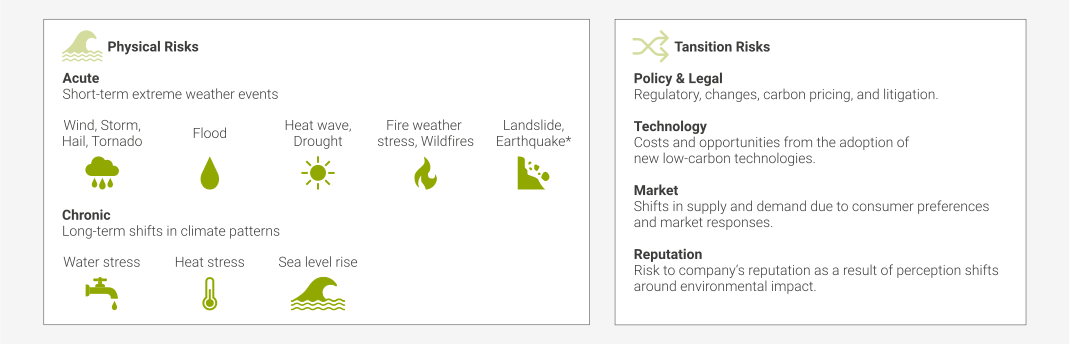
PolyPeptide used a semi-quantitative as well as qualitative approach including different scenarios to assess climate-related physical and transition risks and opportunities within the categories highlighted below.
Physical and transitional risks
Financial impact assessment
The Group assessed the physical and transition risks, and then the potential financial impact associated with each risk type was then estimated. Climate-related issues may affect the Group’s financial position in various ways, including:
- Higher direct and indirect operating costs (e.g., energy, raw materials and transportation costs, and insurance,
- Increased capital expenditure in low-carbon technologies and innovation,
- Potential loss of revenues due to changing customer behavior; and/ or
- Exposure to fines or penalties.
The financial impact assessment considered all the aforementioned factors.
Climate scenarios
In its 6th assessment report (2023), the Intergovernmental Panel on Climate Change (IPCC) emphasized the use of advanced climate change scenarios to support long-term planning. These scenarios, known as Shared Socioeconomic Pathways (SSP1, 2, etc.) provide comprehensive narratives describing how society may evolve throughout the 21st century and how such developments could influence climate outcomes. These SSP scenarios offer broader and more tangible narratives on potential human responses to the challenges posed by climate change.
These scenarios complement and build on earlier versions that focused on projected temperature increases due to the progression of greenhouse gas concentrations, defined as Representative Concentration Pathways (RCP2.6, 4.5, 8.5, etc.). The Munich Re Location Risk Intelligence Tool supports this scenario-based approach by offering climate risk data across various SSP scenarios, thereby enabling the integration of physical risks into informed decision-making processes.
An essential element of the scenario analysis is choosing a range of scenarios that encompass a broad spectrum of potential future results, including both positive and negative outcomes. For its physical risk assessment performed in 2024, PolyPeptide used an optimistic, a moderate and a worst-case SSP scenario1 to facilitate challenging “what if” analyses, encompassing a broad spectrum of assumptions about future developments, including projected warming at the end of the 21st century relative to the pre-industrial period (1850–1900):
- SSP1-2.6 (Sustainability) A sustainable world with fast decarbonization, strong global cooperation, as well as social and economic changes with a projected warming of around 1.0–2.4°C
- SSP2-4.5 (Middle of the road) moderate growth and slow climate action, fossil and renewable energy mix and some corporation with projected warming of around 2.1–3.5°C
- SSP5–8.5 (Fossil-fueled development) increasing fossil fuel use and emissions, high-consumption world with weak climate policies and expected warming of around 3.3–5.7°C
Physical risks
For the assessment of physical risks, PolyPeptide used the Munich Re Location Risk Intelligence Tool (Munich Re Tool), which evaluates numerous risks with high spatial resolution, with the support of external consultants from the Climate&Strategy Foundation. For each of PolyPeptide’s manufacturing sites, the Munich Re Tool reports were reviewed and supplemented with an analysis on a topographic map. Subsequently, flood and sea level rise risks were assessed using national or regional flood risk maps.
The Group conducted a physical risk vulnerability assessment for its manufacturing sites, considering factors like turnover contribution, asset damage risk, and water-related risks (e.g., drought). For the latter, PolyPeptide extended the analysis by considering the site’s water usage. By aggregating the actual business risks associated with physical threats and their projected severity, using Munich Re Tool evaluations and supplemented by additional risk analyses, the Group assigned each site likelihood and vulnerability ratings using a five-tier scale (low, medium-low, medium, medium-high, high) across seven distinct risk categories.
The categorization of physical risks is presented in the table below. The risks are assessed across three time horizons (2030, 2050, and 2100, respectively), based on IPCC key dates and represent a risk trend of the SSP5–8.5 scenario. Risks were linked to operational impacts like heat stress, higher energy use, potential blackouts, and reduced working hours, and rated as low, medium, or high. Relevant primary responses and mitigating measures addressing these risks are also highlighted.
Climate-related physical risks for PolyPeptide’s manufacturing sites
|
Risk group |
Risk name |
Potential financial impact description |
Climate scenario trend 2030 to 2100 |
Overall risk score |
Primary response to risk |
||
|
Chronic - Temperature |
Heat stress, Water stress |
• |
Higher electricity demand |
Increase (from medium-low to medium risk) |
Low |
• |
Energy efficiency and backup power systems |
|
• |
Reduced number of working hours |
• |
Backup water sources for essential operations |
||||
|
• |
Monitoring of water purifying systems |
||||||
|
• |
Installation of equipment to control workplace temperatures |
||||||
|
Acute - Extreme heat |
Heat waves, Droughts |
• |
Higher electricity demand |
Stable (medium-low risk) |
Low |
• |
Energy efficiency and backup power systems |
|
• |
Reduced number of working hours |
• |
Backup water sources for essential operations |
||||
|
• |
Monitoring of water purifying systems |
||||||
|
• |
Installation of equipment to control workplace temperatures |
||||||
|
Acute - Wind/Storm |
Tropical cyclone, Extratropical Storm, Hail, Tornado |
• |
Damage to property |
Stable (medium-low risk) |
Low |
• |
Increase in stock of critical raw materials |
|
• |
Supply chain disruptions |
• |
Backup power systems |
||||
|
• |
Scheduled relocation of operations |
||||||
|
Acute - Water |
Fluvial flood, Pluvial flood, Flash flood |
• |
Damage to property |
Stable (medium-low risk) |
Low |
• |
Increase in stock of critical raw materials |
|
• |
Supply chain disruptions |
• |
Scheduled relocation of operations |
||||
|
Acute - Fire |
Fire Weather Stress, Wildfires |
• |
Damage to property |
Increase (from medium-low to medium risk) |
Low |
• |
Increase in stock of critical raw materials |
|
• |
Supply chain disruptions |
• |
Backup power systems |
||||
|
• |
Reduced number of working hours |
• |
Backup water sources for essential operations |
||||
|
• |
Smoke hazard |
• |
Scheduled relocation of operations |
||||
|
Acute - Solid mass |
Landslide, Earthquake |
• |
Damage to property |
Stable (medium-low risk) |
Low |
• |
Increase in stock of critical raw materials |
|
• |
Supply chain disruptions |
• |
Backup power systems |
||||
|
• |
Scheduled relocation of operations |
||||||
For each risk category, the overall risk score is derived by determining an inherent risk score that combines the potential financial impact and likelihood of each climate-related risk, and then reassessing that score after considering the level of control provided by existing mitigation measures. Stronger controls reduce the inherent risk score to a lower overall risk score, while limited controls mean the overall risk remains closer to the original assessment.
The scenario analysis results suggest that PolyPeptide’s manufacturing sites are generally not substantially vulnerable to climate-related physical risks. Nonetheless, a detailed examination of individual sites enables prioritization of locations and resources for risk adaptation and mediation:
- The location in India is potentially exposed to flash floods, currently assessed as medium-low under various climate scenarios by 2030, with the risk possibly escalating to medium by 2050 and 2100 in scenarios of moderate and fossil-fuel intensive development.
- Europe is experiencing an increased frequency of extratropical storms, which can negatively impact operations, albeit typically in the short term.
- Locations in the US are exposed to tornadoes, which could disrupt operations.
- Additionally, California is susceptible to earthquakes. While not connected to climate change, these seismic events can lead to substantial property damage, power outages, and disruptions in the supply chain.
- Climate change signifies a substantial shift in temperatures, affecting all manufacturing locations. The risk of heatwaves can result in blackouts, surges in electricity demand, and considerable effects on employees’ health and well-being. Additionally, temperature changes are likely to increase water demand even as global availability diminishes.
To identify priority areas in the Group’s upstream value chain that may be vulnerable to climate-related physical risks, a further scenario analysis of its primary suppliers covering over 40% of the total addressable spend was conducted. The findings indicate that supplier locations are at a higher risk of physical threats than PolyPeptide’s production facilities.
The risks include an increase in the frequency and severity of floods and tropical cyclones in Asia, while suppliers in Europe, particularly in Greece, face the threat of rising average temperatures, heatwaves, and droughts. These conditions may lead to increased costs for goods sourced by the Group and, in certain instances, could result in operational halts and shipment delays.
The mitigation strategies determined from this analysis involve:
- obtaining supplier business continuity plans;
- qualifying alternative suppliers; and/ or
- establishing a program for the systematic evaluation of key suppliers (those in the upstream supply chain of essential materials or with a substantial portion of the Group’s expenditures) concerning the impact of climate change.
Transition risks and opportunities
For the identification of the transition risks, PolyPeptide followed a qualitative multi-step approach, involving internal specialists from different functions. The process started with a benchmark analysis. This served as basis for an expert workshop with the involvement of Internal Audit, Global Engineering and Manufacturing Technology, Global Procurement, Legal and Compliance, Investor Relations, and Global EHS. The workshop comprised both an educational segment and an assessment phase. Consequently, a revised list of potential transition risks has been compiled for further analysis in an internal stakeholder survey. The survey was used to evaluate the following aspects:
- perception of risk and its potential impact on the Group,
- time horizon of the risks (short-, medium-, and long-term),
- geographic occurrence and financial effects,
- likelihood, magnitude, and primary response to each risk.
Consequently, a final list of transition risks was compiled, examined, prioritized, and assessed regarding their potential financial impact, likelihood and level of control. A potential financial impact assessment is made for each risk which results with only two risks identified as moderate.
Identified transitional climate-related risks
|
Risk group |
Risk name |
Time horizon |
Potential financial impact description |
Overall risk score |
Primary response to risk |
||
|
Policy and Legal |
Carbon pricing mechanisms / Increased pricing of GHG emissions |
Medium-term |
• |
Increased direct costs |
Low |
• |
Infrastructure, technology, and spending |
|
• |
Increased indirect [operating] costs |
||||||
|
Enhanced emissions-reporting obligations |
Short-term |
• |
Increased indirect [operating] costs |
Low |
• |
Compliance, monitoring, and targets |
|
|
• |
Fines, penalties or enforcement orders |
||||||
|
Non-compliance with regulations |
Medium-term |
• |
Fines, penalties or enforcement orders |
Low |
• |
Compliance, monitoring, and targets |
|
|
Market |
Changing customer behavior |
Medium-term |
• |
Decreased revenues due to reduced demand |
Moderate |
• |
Compliance, monitoring, and targets |
|
• |
Increased direct costs |
• |
Infrastructure, technology, and spending |
||||
|
Increased cost of raw materials |
Medium-term |
• |
Increased direct costs |
Low |
• |
Infrastructure, technology, and spending |
|
|
Technology |
Costs of transition to lower emissions technology |
Medium-term |
• |
Increased direct costs |
Low |
• |
Infrastructure, technology, and spending |
|
Transition to increasing recycled content |
Medium-term |
• |
Increased capital expenditure |
Moderate |
• |
Infrastructure, technology, and spending |
|
short-term: 0–2 yrs,
medium-term: 2–5 yrs,
long-term: 5–15 yrs.
The result presented in the table above represents the time horizon the transitional risk is expected to surge.
PolyPeptide also evaluated climate-related opportunities as shown in the table below, focusing on enhancing the efficiency of its production processes and use of low-carbon energy sources
In terms of production efficiency, PolyPeptide considers its Green Master Plan as a critical, integral element of its strategy. The Group’s innovation and technology team coordinates innovation efforts, while the manufacturing sites handle implementation. The program prioritizes reducing the quantity of solvents and reagents relative to production volumes, substituting hazardous chemicals with greener alternatives, and creating solvent recycling opportunities. The Group collaborates with customers during the initial stages of product development and upgrades its manufacturing infrastructure to support its innovative technical capabilities.
PolyPeptide refined its Green Master Plan in 2023, aiming for the efficient use of chemicals to mitigate its climate change impact. In 2025, the Group revised its Global EHS Policy statement, committing to an integrated and certified environmental management system at all manufacturing sites in accordance with ISO14001:2015. With the progress made over the last two years, all manufacturing sites operated in 2025 with this certification. Moreover, the EHS policy statement underscores the Group’s dedication to green chemistry from early development stages and establishing production capacities for its application. Additionally, the Group promotes circular waste management by minimizing waste, enhancing waste stream recycling/recovery, and advancing solvent recycling methods.
Climate-related transition opportunities
|
Opportunity group |
Opportunity name |
Time horizon (main geography) |
Potential financial impact description |
Strategy to realize the opportunity |
|
|
|
|
|
|
|
Increased efficiency of production and/or distribution processes |
Green program, green chemistry, recycling of solvents |
Short-term (Europe, US, India) |
Reduced direct costs |
Green program involves departments like Innovation, Development, EHS, and Engineering, and they currently work in close collaboration to define goals, governance, and actions |
|
Segregation of water in waste of solvent to reduce the quantity of incinerated waste |
Medium-term (Sweden) |
Reduced direct costs |
Business case evaluation in progress |
|
|
|
|
|
|
|
|
Use of low-carbon energy sources |
Switching to electricity from renewable sources |
Short-term (France, US) |
Increased revenues resulting from increased demand for products and services |
In 2025, an electricity contract in Ambernath securing 100% renewable electricity supply was finalized, bringing the share of renewable-sourced electricity to 80.6% in 2025 |
|
|
|
|
|
|
|
Use of recycled material for GMP activities |
Recycling of solvent and reuse of recycled solvent for GMP activities |
Medium-term (US, Belgium) |
Reduced direct cost |
Development of partnership with recycle plant |
Additionally, the ERM identifies a range of risk types that may interact with climate-related risks:
Overview of risk categories that correlate with climate change
|
Risks |
Risk owners |
Mitigation measures |
|
|
Customer relationships |
Global Sales & Marketing |
• |
Contract with specific requirements in terms of sustainability including greenhouse gas emissions, and defined rules if targets are not achieved |
|
Manufacturing delays (operational execution) or interruptions |
Global Operations |
• |
Business continuity plans at each manufacturing site, including sharpened sourcing strategy |
|
• |
Insurance |
||
|
Supply chain |
Global Procurement |
• |
Direct engagement with suppliers to mitigate supply chain risks |
|
• |
Supplier contracts with fixed prices |
||
|
Environmental, health, and safety laws and regulations |
Global EHS |
• |
EHS regulation monitoring and compliance assessment |
|
• |
Significant new CAPEX projects might require specific assessments of regulatory requirements |
||
|
Hazardous chemicals manufacturing and storage |
Global EHS |
• |
Development of emergency and response plan |
|
• |
Business continuity plans at each manufacturing site and facility maintenance plan to anticipate risks |
||
|
• |
Periodical environmental monitoring |
||
Resilience – climate change
PolyPeptide is committed to implementing green chemistry principles to reduce the environmental impact of its manufacturing processes. The Group is dedicated to advancing green chemistry in projects from initial development stages. The production of peptide-based APIs necessitates substantial quantities of raw materials, such as solvents. PolyPeptide is committed to enhancing environmental sustainability through a robust green program aimed at reducing, recycling, replacing, or altogether avoiding the use of hazardous solvents in production.
The Group’s specialists work with external experts and collaborations, exchanging industry trends in roundtables and with expert groups to push the industry forward and make the production of API more sustainable. The Group aims to engage with customers during the initial phase of product development and consistently enhances its manufacturing infrastructure to support this collaboration. It recognizes that ever-evolving legal and regulatory demands, coupled with increasing costs of raw materials and energy, could adversely affect PolyPeptide’s financial profile. Therefore, embracing innovative manufacturing techniques not only aligns with customer expectations, but also bolsters the Group’s market position and safeguards its competitiveness.
Overall, considering the various climate-related scenarios assessed, PolyPeptide believes its strategy and business model remain resilient under different plausible future conditions. This approach focuses on managing supply chain risks, advancing research and development, leveraging technological innovations (particularly in solvent recycling), and engaging stakeholders. A key element of this strategy is maintaining close dialogue with customers to ensure their needs, including those related to climate concerns, are effectively met.
PolyPeptide’s transition plan formalizes the Group’s intended contribution to keeping climate change-induced warming below 2°C, a trajectory that is overall implied by the SSP1-2.6 scenario. Using climate scenario-based projections enables PolyPeptide to iterate the transition plan so that identified climate-related opportunities outweigh the risks, with the goal to keep and increase resilience of the Group’s business model.