Strategy
Company profile
PolyPeptide is a focused contract development and manufacturing organization (CDMO) specializing in the development and manufacturing of synthetic peptides used as active pharmaceutical ingredients (APIs) or intermediates in therapeutic products. It serves a diversified customer base of around 250 academic, pharmaceutical, and biotech companies around the world. It also produces a range of generic peptides and peptides used in animal health and medical devices.
With a history of over 70 years and a strong manufacturing track record with over 1,000 distinct therapeutic peptides manufactured for customers, the Group has developed into a full-service drug substance provider with differentiated technologies and capabilities to support complex and innovative drug development projects.
As a CDMO, PolyPeptide is subject to comprehensive regulations, including current Good Manufacturing Practices (cGMP), to assure quality and to ensure the safety of patients. The Group runs a global network of six clinical development and commercial manufacturing sites in Europe, the United States of America, and India, with each of the sites subject to regular inspections by regulatory agencies and audits by its customers. All sites are cGMP certified, demonstrating suitable processes, methods, facilities, and controls.
Beyond the rigorous regulatory environment, PolyPeptide’s market is characterized by distinct structural factors that create high barriers to entry and high switching costs for customers. These factors include the specialized technical expertise and knowledge required to meet customer specifications in relation to quality, reliability and security of supply, the high capital intensity of manufacturing, and the importance of an established track record.
Business model
PolyPeptide provides its offering through its manufacturing sites and with a “start here – stay here” philosophy, covering the entire life cycle of a drug, starting with the customer’s pre-clinical drug development projects, followed by clinical phases through to commercialization. As a result, its customer relationships are typically strategic and long-term by nature.
PolyPeptide’s business model
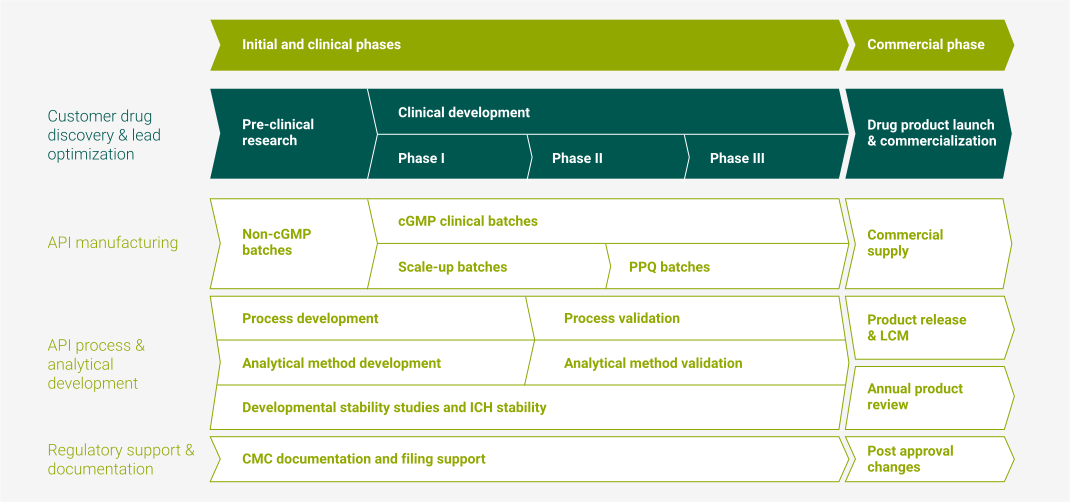
Activities include process and analytical method development and stability studies as well as the production of APIs and intermediates. In addition, the Group provides its customers with regulatory documentation and support.
Revenue related to drug development projects results from the Group’s active custom projects pipeline and includes the manufacturing of non-cGMP material for pre-clinical studies and cGMP material for clinical phases. Once a drug has received regulatory approval, PolyPeptide recognizes related sales as commercial revenue. Most of PolyPeptide’s commercial revenue originates from projects that were acquired through development programs, which later secured regulatory approvals.
PolyPeptide maintains a holistic quality system to ensure compliance with cGMP and adherence to applicable guidelines, including those from the International Council for Harmonization of Technical Requirements for Pharmaceuticals for Human Use (ICH).
Market
According to GlobalData drug database, accessed in February 2026, the global peptide therapeutics market has been valued at approximately USD 68 billion in 2024 and is projected to reach approximately USD 175 billion by 2031 with a compound annual growth rate (CAGR) of around 15% from 2024 to 2031.
PolyPeptide believes that one of the main growth drivers is the increasing demand for peptide-based therapies for metabolic disorders, in particular for the treatment of diabetes, obesity, and other co-morbidities. Based on a third-party market report from August 2024, obesity and type 2 diabetes mellitus (T2DM) present major global health challenges, with an increasing prevalence worldwide. GLP-1 receptor agonists are an established therapeutic option, which is evolving towards offering various formulations differing in efficacy, dosing and routes of administration. The future of incretin-based therapies is observed to move towards novel agents which are dual or triple hormonal agonists. Next to metabolic disorders, the advancement of hundreds of pre-clinical and clinical development projects in other therapeutic areas, including oncology, central nervous system, infectious disease, cardiovascular, gastrointestinal, and immunology, is expected to further complement the growth.
PolyPeptide observed that the global drug development landscape remains focused on synthetic peptides with complex molecular structures, including longer sequences, chemical modifications, and the incorporation of non-natural amino acids, alongside novel formulation technologies such as oral peptides. PolyPeptide believes that its specialized CDMO capabilities remain relevant in customer outsourcing considerations, including in the context of more regionalized supply chain strategies in the current macro‑economic environment.
According to the GlobalData drug database, accessed in February 2026, approximately 800 peptide drug projects (synthetic and recombinant) were in development, of which approximately 300 were in clinical development, with over 80 in phase III and pre-registration. GlobalData has recorded over 250 planned, ongoing and completed Phase III clinical trials involving peptides in 2025, which PolyPeptide believes underscores their versatility and broad applicability across multiple indications. Based on third-party market reports, over 100 peptide-based therapies were approved by the US Food and Drug Administration (FDA) as at the end of 2025.
The addressable market for PolyPeptide is the outsourced market for synthetically manufactured peptide-based APIs and intermediates. It was estimated by PolyPeptide, based on public company reports from the financial year 2024, to be valued around USD 2.5 billion in 2024. Out of the approximately 800 peptide drug projects in development, above 80% are estimated to be synthetically manufactured.
Strategy
Vision, mission, values
PolyPeptide’s vision is to be the most innovative peptide CDMO by shaping the future of peptide drug manufacturing and contributing to the health of millions of patients across the world.
The Group’s mission is to help customers develop products, secure regulatory approvals, and successfully launch and commercialize their products by combining cGMP-compliant manufacturing practices with efficient and sustainable technologies. Focusing on peptides, the Group supports customers from early development through commercial scale.
Building on its values of “Innovation”, “Excellence” and “Trust”, PolyPeptide aims to be the preferred long-term partner for its customers throughout the entire drug life cycle.
Customers expect their CDMO to have deep scientific knowledge, technical expertise, and operational experience, demonstrating a relentless focus on quality and high delivery performance. PolyPeptide strives to meet and exceed these expectations.
Strategy update
In 2025, PolyPeptide focused on advancing the execution of its growth strategy.
Building on its multi-site network, PolyPeptide’s strategy aims at strengthening both its foundations and competitive advantages:
- The foundation consists of operational and quality excellence, industrial-scale capabilities, talent and working culture with a commitment to meeting the Group’s corporate responsibilities and sustainability objectives.
- The competitive advantages center around innovation, with a focus on green chemistry, process intensification and process design, superior pipeline development capabilities, and rapid and flexible capacity expansion that leverages the potential for modularity.
By executing its strategy, PolyPeptide seeks to offer its customers a distinctive value proposition that further differentiates it from competition and that offers a platform that enables its customers to advance complex peptide molecules toward becoming medicines reaching patients worldwide.
PolyPeptide’s strategy
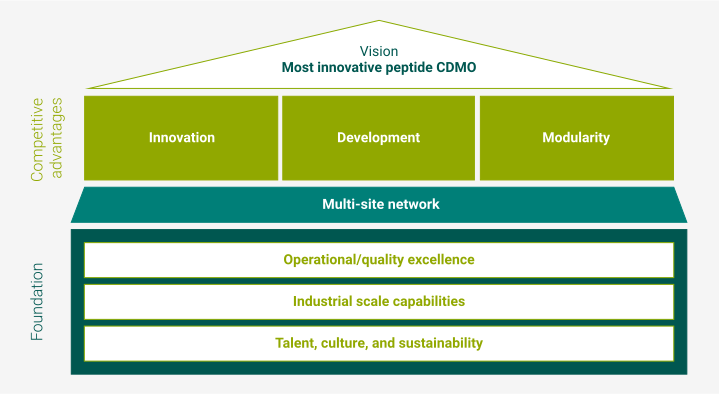
To execute its strategy, the Group remains committed to continually strengthening its core foundations:
Operational and quality excellence: PolyPeptide strives to meet customer requirements in terms of quality, quantity, and time. The design of operational and quality processes is key to reducing technical and business risks while meeting performance standards. PolyPeptide’s operational and quality excellence programs focus on optimizing production planning and execution, enhancing technical proficiency, and sharing best practices across the manufacturing network. Execution requires a continuous improvement mindset to achieve increased efficiency and capacity utilization.
Industrial scale capabilities: Given the strong demand and expected peptide therapeutics market growth, the industry needs to evolve its capabilities to satisfy large-scale manufacturing requirements. To support industrial-scale production, PolyPeptide employs proprietary technology and integrated engineering (including improved process controls and enhanced automation) to drive productivity, safety, and sustainability. In 2025, PolyPeptide broadened its sourcing options for key materials. In addition to its long-term partnership with Flamma, it established a more robust and flexible supply chain for peptide manufacturing via its strategic alliance with Lupin Manufacturing Solutions (LPM). Furthermore, to ensure a seamless transition between drug substance (DS) and drug product (DP) in the US, PolyPeptide entered into a collaboration agreement with Lifecore. The collaboration will leverage PolyPeptide’s strong capabilities in peptide manufacturing and development in combination with Lifecore’s expertise in formulation, fill/finish, and packaging in the US.
Talent, culture, and sustainability: As a CDMO focused on the development and manufacturing of synthetic peptides, PolyPeptide operates in a specialized field employing a highly educated workforce. By the end of 2025, 64% of its employees held academic degrees and 7% held PhDs in various relevant fields, including in chemistry and engineering. The talent agenda has been further focused on enhancing the organization with industrial-scale manufacturing and supply chain capabilities, while strengthening competences for strategic growth readiness. Furthermore, the Group adheres to fundamental principles of business ethics, corporate responsibility, and compliance and integrates relevant criteria into its strategy and operations to cultivate sustainable value creation over the long term.
Building on these core foundations, PolyPeptide aims to achieve excellence through its competitive advantages:
Innovation: PolyPeptide is focused on innovative manufacturing technologies, while improving environmental sustainability. The importance of PolyPeptide’s green chemistry agenda is further fueled by the growing volume of products and the increasing complexity of their structures. In particular, PolyPeptide’s green chemistry agenda focuses on solvent reduction, green solvents and reagents, and solvent recycling. In parallel, PolyPeptide focuses on process intensification to enhance production efficiency by optimizing speed, reaction throughput, and yield. One exemplary application includes the development of a high-capacity SPPS resin enabling optimized volumetric capacity. PolyPeptide further concentrates on the development of process design standards and flexible technology platforms to enable a high-throughput modular manufacturing approach.
Development: PolyPeptide strives to offer customers superior manufacturing processes and analytical methods, grounded on a partner focused approach from early-stage to late-stage development. With more than 70 years of manufacturing experience, PolyPeptide’s regarded development capabilities stem from its (i) agile mindset, attentive to evolving customer needs, (ii) customer proximity and high responsiveness via its multi-site network, and (iii) ability to build long-term trusted relationships. These strengths are reflected in PolyPeptide’s rich pipeline of 196 active custom projects across therapeutic areas, including an exposure to metabolic of approximately 20% of the active custom projects pipeline.
Modularity: Through a standardized, modular approach, PolyPeptide aims to accelerate implementation, enhance adaptability, maximize output, and reduce risks. This approach is expected to enable (i) rapid deployment of manufacturing capacity, shortening time‑to‑market through standardized modules, (ii) flexibility to adjust capacity according to demand, (iii) increased process throughput by applying optimal process design and, lastly, (iv) mitigated risks during implementation and qualification by relying on a consistent, standardized design.
PolyPeptide is implementing its growth strategy across its global network of six cGMP- certified manufacturing sites in Europe, the United States of America, and India. As part of its strategy, PolyPeptide is advancing its capacity expansion roadmap with targeted capex investments. By the end of 2025, it achieved the ramp-up of its new large-scale facility in Braine-l’Alleud, Belgium, to its target utilization rate. In addition, the Group marked a significant milestone on its SPPS capacity expansion project in Malmö, Sweden, with the delivery and installation of pre-built modules on site, which are now undergoing mechanical completion. The newly added SPPS capacity at the site in Strasbourg, France, has become operational and is expected to ramp up production throughout 2026. PolyPeptide also announced an investment at the Ambernath, India, facility, planned to increase production capacity transforming into a larger, more diversified site. Lastly, In Torrance, plans were made in late 2025 to expand downstream capacity.
The Group maintains a Global Balanced Scorecard to support the implementation of its strategy and operational plans. In addition to the financial targets for a given period, the scorecard includes sustainability performance objectives.
For more details, refer to the Sustainability Report and the Remuneration Report. For the review of the financial and operational performance, including the guidance for 2026, refer to the Business Review.
Mid-term outlook
PolyPeptide confirms its target to double revenue reported for 2023 by 2028. Revenue growth projections are supported by commitments and supply forecasts of existing customers.
Profitability is expected to approach an EBITDA margin of 25% by 2028, driven by growth initiatives, improving profitability in the existing base business with higher asset utilization and efficiency as well as operating leverage.
Capital expenditures of 15% to 20% of revenue are required to ensure capacity also beyond 2028. PolyPeptide plans to expand manufacturing capacity in an efficient way, capitalizing on its existing multi-site network and proprietary technology to maximize manufacturing throughput.
PolyPeptide plans to build additional capacity in phases in line with specific customer projects and their growth trajectory. The phasing of the capacity being made available is expected to result in an uneven year-on-year growth in revenue and operational expenses, impacting profitability for a given period.
PolyPeptide’s guidance and mid-term outlook assumes, no unexpected adverse events.