5Compensation framework for the Executive Committee
5.1Remuneration approach
Pursuant to art. 26 of the Articles of Association, the compensation of the members of the Executive Committee is determined by the entire Board of Directors based on the proposal of the RNC and subject to and within the limits of the aggregate amounts approved by the general meeting. Regarding the compensation of the members of the Executive Committee (other than the CEO), the RNC works in consultation with the CEO.
In principle (and as set forth by the Organizational Regulations), members of the Executive Committee shall attend designated and selected sections of the meetings of the Board and RNC meetings as guests without the right to vote, except where not appropriate (e.g., if particular matters relating to their performance or remuneration are discussed). Compensation to members of the Executive Committee may be awarded in cash, in the form of shares in the Company and other benefits.
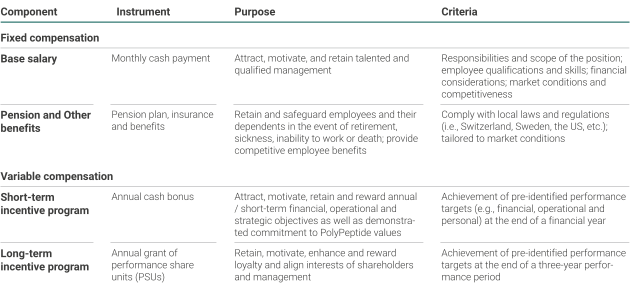
The remuneration framework for members of the Executive Committee consists of fixed base compensation in cash as well as variable compensation elements. The fixed compensation comprises the base salary, pension and other benefits. The variable compensation comprises short-term and long-term compensation components.
Below is an overview of the current remuneration framework for the Executive Committee.
Table 8:Remuneration framework for the Executive Committee
5.1.1Base salary
The base salary for each member of the Executive Committee is a fixed component of compensation paid in cash on a monthly basis depending on market practice. The base salary reflects the scope and key responsibilities of the role as well as the qualification and skills required to perform the role, along with the employee’s individual skill set, qualifications and experience. Financial considerations, such as budget and affordability, are also evaluated together with market conditions and competitiveness (see section 2 “Remuneration philosophy and principles” of this Remuneration Report for further information regarding benchmarking analyses).
5.1.2Pension and Other benefits
Pension and Other benefits provide security for employees and their dependents in the event of retirement, sickness, inability to work or death. The members of the Executive Committee participate in the pension and social insurance schemes in the countries where their employment contracts were entered into or where they are resident, as the case may be. As such, the plans vary according to local market practice and regulations; however, at a minimum, they reflect the statutory and collective agreement requirements of the respective countries. For example, in line with local employment practice for Swiss employees, all employees under Swiss employment contracts are covered by a supplementary non-compulsory occupational welfare plan in addition to PolyPeptide’s compulsory occupational pension scheme.
We also offer competitive employee benefits. Depending on market practice, such additional benefits may include a company car or car allowance, health coverage, variable vacation supplement, etc. and, where relevant, relocation-related and international benefits, such as executive benefits allowance or reimbursements, tax advisory services, etc. In addition, to the extent applicable and as supported by appropriate documentation and verification, supplemental cash awards to incoming Executive Committee members to compensate for remuneration forfeited at the previous employer are reported as “Other benefits”. The monetary value of any of these remuneration elements is disclosed in the compensation tables.
Out-of-pocket expenses incurred by members of the Executive Committee in connection with their employment services for PolyPeptide are duly reimbursed in accordance with the applicable regulations and are not considered to be compensation subject to approval and, hence, are not further considered in the compensation tables presented further below.
5.1.3Short-term incentive program
5.1.3.1Overview
The short-term incentive program (“STIP”) is an annual cash-based incentive program intended to motivate and reward the Executive Committee to deliver on PolyPeptide’s short-term financial, operational and strategic objectives.
In accordance with art. 26 of the Articles of Association, the STIP performance targets are determined in advance by the Board of Directors, upon recommendation of the RNC, for one financial year, where any awards are based on the audited consolidated financial statements for that specific financial year (as applicable). Performance targets are determined on an annual basis for each member of the Executive Committee, taking into account such member’s position, responsibilities, and tasks, before or at the beginning of the one-year performance period. Pay-outs are subject to caps that are expressed as pre-determined multipliers of the respective performance target levels.
We set rigorous STIP financial performance targets to drive best-in-class financial and operational results. These annual targets are derived from the Group’s budget and mid-term strategic plan, ensuring alignment with PolyPeptide’s long-term objectives. In parallel, individual performance targets, typically qualitative and strategic in nature, cover areas such as leadership, organizational development, adherence to PolyPeptide’s values, and management of strategic projects. Together, these objectives motivate the Executive Committee to deliver on the Group’s priorities.
As a guiding principle, all financial, operational, and individual targets incorporate meaningful improvements over prior-year achievements. Given their commercially sensitive nature, disclosing specific STIP targets would reveal privileged insights into PolyPeptide’s strategy and create a competitive disadvantage. Therefore, we do not publish detailed targets, but provide a general commentary on achievement at the end of the performance cycle (e.g., see Table 14 in section 5.2.1 “Overview and performance assessment” of this Remuneration Report for an overview of the STIP target performance in 2025).
Following the end of the applicable financial year, the RNC assesses the achievement of the STIP financial and operational performance targets and calculates the corresponding payout factor, which is subject to approval of the Board of Directors. For the individual performance component, the RNC conducts an assessment of the individual contributions of each member of the Executive Committee and includes the corresponding payout factor in its proposal to the Board of Directors.
In case of termination of employment before the payout of the respective STIP, the STIP payout may be forfeited, prorated or reduced depending on the conditions of such termination and subject to applicable law. Any STIP awards are paid in cash by 30 June following the approval of the applicable audited consolidated financial statements and are subject to clawback provisions.
5.1.3.22025 STIP
For the year ended 31 December 2025, the individual target incentive amount for the CEO corresponded to 75% of the base salary and for the other current members of the Executive Committee in office as of 31 December 2025 between 30–35% of the base salary depending on the role. The maximum payout amount for the CEO was equivalent to 112.5% of the base salary and for the other current members of the Executive Committee in office as of 31 December 2025 between 45–52.5% of the base salary.
Currently, payouts under the STIP are calculated based on the achievement level of the respective performance targets, with 100% achievement resulting in 100% payout. For each quantitative performance target, there is a minimum threshold performance level of 85% achievement of the performance target, below which there is no payout. There is also a maximum performance level of 115% achievement of the performance target, at which threshold the payout is capped at 150%. For each qualitative performance target (including the sustainability targets), appropriate deliverables, ranges and/or milestones are defined at the start of the reporting period and subsequently assessed at the end of the reporting period. Linear extrapolation is used to calculate the payout between the minimum threshold and target, and target and maximum. Thus, total payout under the STIP can range from 0% to 150% of the target incentive amount.
For the year ended 31 December 2025, the STIP objectives for the Executive Committee comprised financial, operational, sustainability and individual performance objectives, as detailed in the table below.
Table 9:2025 STIP performance objectives and weighting for the Executive Committee
|
Focus in 2025 |
Performance objective |
Weighting |
|
Growth |
Revenue |
30% |
|
Profitability |
EBITDA |
35% |
|
Liquidity and operational efficiency |
Net Working Capital |
15% 1 |
|
Sustainability |
Green Chemistry and Climate Strategy |
5% |
|
Individual performance |
Personal objectives |
15% |
To promote engagement and alignment within the Executive Committee, STIP performance metrics are weighted consistently for all members: 85% based on Group-wide performance criteria and 15% on individual objectives. These objectives were selected as key value drivers for PolyPeptide, rewarding efforts that support growth, liquidity, operational efficiency, profitability and long-term value creation. In addition, dedicated sustainability objectives underscore PolyPeptide’s commitment to (i) green chemistry by measuring progress in reducing solvent consumption and advancing green solvent projects, and (ii) the reduction of CO2 emissions (see also Sustainability Report 2025).
5.1.4Long-term incentive program
5.1.4.1Overview
The share-based long-term incentive program (“LTIP”) is designed to motivate, reward and retain key employees by providing them with the opportunity to become shareholders as well as participate in the future long-term success and prosperity of PolyPeptide. Furthermore, the LTIP is intended to align the interests of eligible employees with those of the Company’s shareholders, to promote a performance culture throughout the organization and to align remuneration with the creation of shareholder value.
In accordance with art. 26 of the Articles of Association, the LTIP takes into account the sustainable long-term performance and strategic objectives of PolyPeptide. Achievements are generally measured based on a period of several years. The long-term compensation pay-outs are subject to caps that may be expressed as pre-determined multipliers of the respective target levels.
The Board of Directors or, to the extent delegated to it, the RNC determines the performance metrics, target levels and target achievement as well as grant, vesting, exercise, restriction and forfeiture conditions and periods in relation to shares or similar rights regarding shares to be awarded. In particular, the conditions may provide for continuation, acceleration or removal of vesting, exercise, restriction and forfeiture conditions and periods, for payment or grant of compensation based upon assumed target achievement, or for forfeiture, in each case in the event of pre-determined events such as a change of control or termination of an employment or mandate agreement. The Group may procure the required shares or other securities through purchases in the market or by using conditional share capital. Compensation may be paid by PolyPeptide or companies controlled by it.
For awards made to any members of the Executive Committee (including the CEO), the Board of Directors approves any granting of PSUs upon recommendation of the RNC. The LTIP award for the Executive Committee, reflecting the value of the PSUs at grant date (i.e., assuming 100% target achievement), will be subject to the maximum aggregate compensation amounts approved by the general meeting for the financial year in which the award is made. The number of shares vesting will depend on the achievements against the targets at the end of the three-year performance period and the LTIP value may vary based on the share price at the time of vesting.
With regard to the CEO, his employment agreement provides for an annual LTIP award target (i.e., assuming 100% target achievement) corresponding to 145% of his base salary for the allocation of PSUs. For the other members of the Executive Committee, their employment agreements provide for an annual target corresponding to between 10–30% of their base salary for the allocation of PSUs depending on the role. In addition, where applicable and supported by appropriate documentation and verification, supplemental LTIP awards may be granted to incoming Executive Committee members to compensate for long‑term remuneration forfeited at their previous employer. Any such LTIP awards are reported as “LTIP grant”. For eligible employees outside the Executive Committee, such individuals will be selected by the CEO based on objective and subjective criteria determined by the Executive Committee.
5.1.4.2LTIP Plan10
In 2025, the RNC continued to oversee the Long-Term Incentive Plan (LTIP) to ensure it supports sustainable, high-quality performance with appropriate risk-taking. The LTIP is structured around three key performance metrics measured over a three-year period: (i) revenue, to drive the Group’s targeted growth; (ii) EBITDA, to reinforce operational performance and profitability; and (iii) Total Shareholder Return (TSR), to promote capitalization recovery and enable a balanced view of the Group’s performance by taking into account PolyPeptide’s shareholders’ perspective. The eligible participant pool currently includes all members of the Executive Committee, the PolyPeptide Management Committee and other key senior leaders in the Group, reflecting the Group’s commitment to fostering accountability and shared success across its leadership team.
According to the Plan, in any calendar year between 1 January and 31 December, inclusive (a “Plan Year”), eligible employees may be awarded the contingent right to receive a certain number of registered Company shares in the future, provided that certain performance and other conditions are achieved (“Performance Share Unit(s)” or “PSU(s)”). Any shares awarded will only be transferred after such PSUs have vested and contingent upon continuous employment (subject to certain limited exemptions).
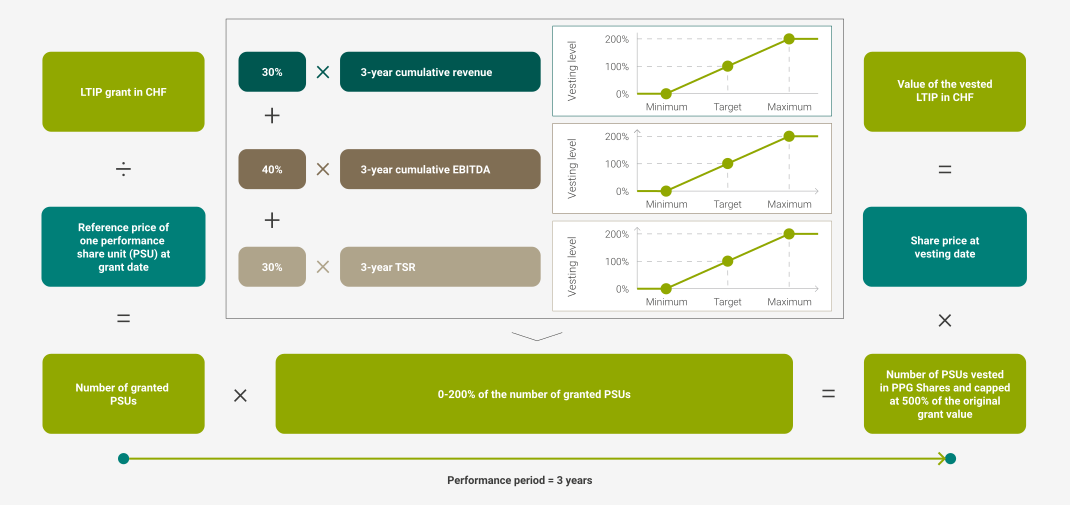
As a rule, the number of PSUs to be granted will equal the award amount (i.e., usually a defined percentage of base salary converted into CHF) divided by the volume-weighted average share price over the last 20 trading days prior to the LTIP grant date. PSUs represent an unsecured, contingent right to the future transfer of shares in accordance with and subject to the restrictions set out in the Plan. PSUs do not provide the participant with any shareholding rights such as dividends, voting rights or the like during the vesting period. The right to receive any PSUs and / or shares under the Plan cannot be settled in cash.
As alluded to above, the vesting of (i) 30% of the granted PSUs will be based on the cumulative revenue; (ii) 40% of the granted PSUs will be based on the cumulative EBITDA; and (iii) 30% of the granted PSUs will be based on TSR, in each case as achieved during the three-year performance period compared to pre-defined performance ranges with minimum, target and maximum goals set by the Board of Directors, upon recommendation from the RNC.
Revenue and EBITDA performance targets are aligned with the Group’s financial reporting cycles (i.e., three full financial years) and are derived from the audited financial statements.
TSR measures the Company’s share performance and total return to shareholders over time by combining share price appreciation and dividends expressed as an annualized percentage. The Company calculates TSR as follows: the compound annual growth rate (“CAGR”) between (i) the 20-day VWAP on the 21st trading day after the Company’s general meeting in the grant year and (ii) the 20-day VWAP on the 21st trading day after the Company’s general meeting relating to the last financial year of the applicable three-year performance period plus cumulative dividends per share distributed to the shareholders during this period (if any). The performance period of TSR is meant to capture and reflect shareholders’ reaction to the Group’s communicated performance outcomes of the preceding financial years.
An illustration of the performance periods for each of the measures is presented in Table 10.
Table 10:LTIP Performance Periods
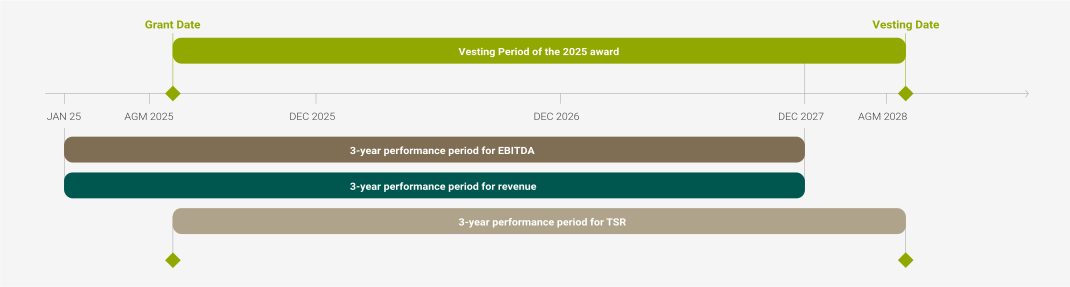
On the vesting date, if the minimum performance for any of the revenue, EBITDA or TSR measures as defined in the performance range is not met, the portion of the PSUs relating to that performance measure expires unconditionally and the respective PSUs do not vest. If the maximum performance is met or exceeded for a performance measure, participants may receive up to 200% of that portion of the PSUs relating to the respective performance measure. Between minimum and target performance as well as between target and maximum performance, the variable factor will increase linearly. The number of vested PSUs is subject to an absolute value cap representing, in each case, 500% of the original grant award.
Table 11:LTIP
The annual LTIP performance targets are set considering a thorough outside-in approach conducted by an external independent advisor modelling future possible performance outcomes for the performance period as well as the Company’s mid-term strategy. The specific revenue, EBITDA, and TSR targets are commercially sensitive. Disclosing these figures could reveal privileged insights into PolyPeptide’s strategy and potentially create a competitive disadvantage. Therefore, if any PSUs vest, we will share information on target achievement at the conclusion of the respective performance period (i.e., for the 2025 LTIP award with the reporting for the financial year 2028, see Table 10).
If PSUs vest and the respective shares are transferred to a participant pursuant to the Plan, that participant will receive an additional number of shares to compensate for missed dividend payments during the vesting period. The number of additional shares will equal the total amount of dividends during the vesting period attributable to the shares transferred to that participant, divided by the volume weighted average share price over the last 20 trading days prior to the vesting date.
Upon recommendation of the RNC, the Board of Directors may in its discretion adjust PSUs as it deems appropriate in the case of variation of share capital (e.g., issues of shares or other equity securities) or other corporate events (other than a change of control) to maintain the value of the PSUs outstanding.
Generally, in case of termination for cause, breach of confidentiality or voluntary termination, PSUs are forfeited without compensation. In certain circumstances, for example the termination of employment as a result of death, all PSU grants will vest with immediate effect on a pro-rata basis at target (based on the period of active employment during the performance period). Upon the occurrence of a corporate event (e.g., change of control due to a merger), all unvested PSUs shall immediately vest at target. In the event of termination of employment due to retirement, permanent disability or if a participant’s employment is terminated without cause effective before the vesting date, any PSUs held will vest at the end of the applicable vesting period(s) on a pro-rata basis.
The Plan further includes malus and clawback provisions that allow for the cancelation or forfeiture of all or part of any unvested PSUs (i.e., malus) or, following vesting of any PSUs, the repayment for all or part of any vested PSUs, shares or cash settlements made under the Plan (i.e., clawback). These provisions apply in cases where, inter alia, the participant (i) engages in any act or omission that is considered malfeasance, fraud or misconduct, (ii) materially breaches any legal, regulatory or contractual obligations and/or internal policy of PolyPeptide, and/or (iii) takes part in any specific conduct that leads (or substantially contributes) to (A) the Company or PolyPeptide having to restate financial statements and / or (B) an inaccurate assessment of any performance or other condition under the Plan pursuant to which the individual LTIP award was made.
5.1.4.3LTIP Plan awards and vesting of prior awards
The following table provides an overview of the granted entitlements (PSUs) under LTIP awards as at 31 December 2025.
Table 12:LTIP award
|
|
LTIP award 2023 |
LTIP award 2024 |
LTIP award 2025 |
Total granted PSUs as at 31 December 2025 |
|
|
|
|
|
|
|
CEO |
34,040 |
38,988 |
66,353 |
139,381 |
|
Executive Committee |
– |
6,030 |
12,624 |
18,654 |
|
Management |
– |
14,055 |
33,854 |
47,909 |
|
Total |
34,040 |
59,073 |
112,831 |
205,944 |
In 2023, the current CEO was the only eligible participant in the LTIP and was granted 34,040 PSUs. The PSUs granted in 2023 will not vest (based on the financial statements for the year ended 31 December 2025) because the minimum performance thresholds for RONOA and EPS over the 2023 – 2025 performance period were not achieved (see section 5.1.4.3 “2023 LTIP Plan awards and vesting of prior awards “ of the Remuneration Report 2023).
5.2Compensation of the Executive Committee
5.2.1Overview and performance assessment
For the year ended 31 December 2025, the Executive Committee received base salary, variable compensation and pension and Other benefits in line with the remuneration framework described in section 5.1 “Remuneration approach” of this Remuneration Report.
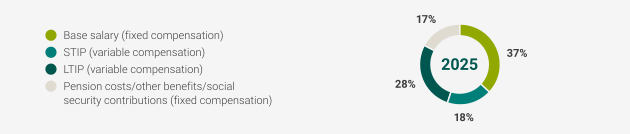
Overall, in 2025, the total variable compensation of the CEO (i.e., STIP and LTIP) amounted to 63.0% of his total compensation and 170.5% of his total fixed compensation (i.e., base salary, pension costs, Other benefits and social security contributions). For the other members of the Executive Committee (excluding the CEO), the total variable compensation (i.e., STIP and LTIP) amounted to an average of 21.9% of the total compensation and an average of 28.0% of the total fixed compensation (i.e., base salary, pension costs, Other benefits and social security contributions). Below is a cumulative overview of the compensation received by the Executive Committee.
Table 13:Breakdown of Executive Committee compensation
In light of PolyPeptide’s reported revenue increase of 15.6% and EBITDA of 12.0%, the STIP 2025 financial performance objectives were between the minimum threshold and target for growth and slightly above the target for profitability. In terms of Net Working Capital, the performance objective’s achievement was above the maximum threshold for H1 2025 and H2 2025. With regard to the sustainability objective, the Group’s overall achievement was between the target and maximum threshold for green chemistry and at the maximum threshold for climate strategy. Upon recommendation of the RNC following its assessments of the respective individuals, the Board determined that the eligible members of the Executive Committee had achieved between 100% and 150% of their respective personal objectives.
Table 14 illustrates the outcome of the STIP performance targets for 2025 (see Table 9 in section 5.1.3.2 “2025 STIP” of this Remuneration Report for an overview of the 2025 STIP performance objectives and weighting for the Executive Committee).
Table 14:2025 STIP performance of objectives1
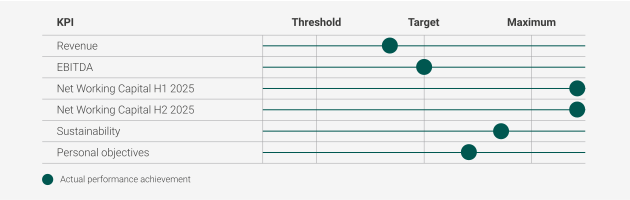
Thus, under the STIP 2025, the combined payout for the financial, operational and individual performance targets is 105.1% of the STIP target incentive amount for the CEO and between 100.6% and 108.1% of the STIP target incentive amounts for the other current and eligible members of the Executive Committee in office as of 31 December 2025.
5.2.2Aggregate compensation of the Executive Committee
The following table shows the total aggregate compensation for the CEO (i.e., Juan Jose Gonzalez) as the highest paid member of the Executive Committee during the period under review as well as the aggregate amount for the other current and former members of the Executive Committee for the period from 1 January 2025 to 31 December 2025.
For the year ended 31 December 2025, the Executive Committee received total remuneration of CHF 4,863,885 (2024: CHF 4,714,606). This is an overall slight increase of 3.2% compared to the previous year, with the main changes explained in greater detail below.
Table 15:2025 Compensation of the Executive Committee(1 January 2025–31 December 2025)
|
CHF |
Juan Jose Gonzalez (CEO) |
Other members of the Executive Committee 7 |
Total |
|
|
|
|
|
|
Base salary |
804,551 |
1,007,485 |
1,812,036 |
|
Pension costs 1 |
106,040 |
162,991 |
269,031 |
|
Other benefits 2 |
44,000 |
163,326 |
207,326 |
|
Social security contributions 3 |
105,247 |
225,784 |
331,032 |
|
Total fixed compensation |
1,059,838 |
1,559,586 |
2,619,423 |
|
STIP bonus 4 |
636,392 |
225,153 |
861,545 |
|
LTIP grant 5 |
1,170,925 |
211,992 |
1,382,917 |
|
Total compensation 6 |
2,867,155 |
1,996,730 |
4,863,885 |
Table 16:2024 Compensation of the Executive Committee(1 January 2024–31 December 2024)
|
CHF |
Juan Jose Gonzalez (CEO) |
Other members of the Executive Committee 7 |
Total |
|
|
|
|
|
|
Base salary |
791,700 |
1,235,348 |
2,027,048 |
|
Pension costs 1 |
105,545 |
166,307 |
271,851 |
|
Other benefits 2 |
24,000 |
119,276 |
143,276 |
|
Social security contributions 3 |
89,119 |
219,768 |
308,887 |
|
Total fixed compensation |
1,010,364 |
1,740,698 |
2,751,062 |
|
STIP bonus 4 |
380,982 |
250,493 |
631,476 |
|
LTIP grant 5 |
1,153,643 |
178,426 |
1,332,069 |
|
Total compensation 6 |
2,544,989 |
2,169,618 |
4,714,606 |
Additional commentary
The summaries below provide additional commentary with regard to the changes in the composition of the remuneration paid to the Executive Committee in 2025 as compared to 2024:
Composition of the Executive Committee: Table 15 reflects the remuneration of the current and former members of the Executive Committee for the period from 1 January 2025 to 31 December 2025, with 4.0 full-time equivalents in total. In 2025, Jens Fricke stepped down as Director Global Operations and member of the Executive Committee as of 10 August 2025. Thus, the totals reflected in Table 15 include, inter alia, (i) the pro-rated compensation paid to Jens Fricke as Director Global Operations up and until 10 August 2025 and (ii) the pro-rated compensation paid to Raoul Bernhardt as Chief Manufacturing and Supply Chain Officer from 11 August 2025 to 31 December 2025.
Table 16 reflects the remuneration of the current and former members of the Executive Committee, with 5.0 full-time-equivalents in total, for the period from 1 January 2024 to 31 December 2024. In 2024, Neil James Thompson stepped down as Director Global Sales and Marketing and member of the Executive Committee as of 26 April 2024. Thus, the totals reflected in Table 16 include, inter alia, (i) the compensation paid to Lalit Ahluwalia as CFO ad interim and member of the Executive Committee during the CFO transition period from 1 January 2024 to 29 February 2024 following Marc Augustin’s commencement as CFO on 1 January 2024 and (ii) the pro-rated compensation paid to Neil James Thompson as Director Global Sales and Marketing as well as compensation paid during his six-month contractual notice period that ended on 1 November 2024.
Base salary: The variance in base salary between 2024 and 2025 (a decrease of 10.6%) is mainly due to the changes in the composition of the Executive Committee, as described above. For members of the Executive Committee in office as of 31 December 2024 and 31 December 2025, respectively, the aggregated base salary levels in CHF increased by 1.3% in 2025 as compared to 2024, mainly due to individual salary increases.
Other benefits: Other benefits increased by 44.7% in 2025 as compared to 2024, mainly due to the changes in the composition of the Executive Committee, as described above, with corresponding differences in applicable local benefits schemes.
STIP: The total payout under the STIP in 2025 is 36.4% higher than in 2024, reflecting the performance levels as described in section 5.2.1 “Overview and performance assessment” of this Remuneration Report. The comparison of the total payouts in 2025 as compared to 2024 is further impacted by the changes to the composition of the Executive Committee, as described above.
LTIP: The LTIP expenses increased by 3.8% in 2025 as compared to 2024 primarily due to the changes in the composition of the Executive Committee, as described above.
Reconciliation of compensation to shareholder resolutions
For the year ended 31 December 2024, the AGM 2023 approved a maximum aggregate amount of fixed and variable compensation for the Executive Committee of CHF 7,000,000 (including all employee and employer social security and pension contributions). One new member was appointed to the Executive Committee after the AGM 2023 (i.e., the CFO); however, no additional compensation amount in excess of that approved by the AGM 2023 has been paid / granted, since the approved aggregate amount of compensation for the financial year 2024 was sufficient to compensate the members of the Executive Committee. The compensation paid / granted to the Executive Committee in the year ended 31 December 2024 amounted to CHF 4,714,606 (including all employee and employer social security and pension contributions). It is thus within the limits of the amount approved by the shareholders’ meeting for the same period.
For the year ended 31 December 2025, the AGM 2024 approved a maximum aggregate amount of fixed and variable compensation for the Executive Committee of CHF 7,000,000 (including all employee and employer social security and pension contributions). One new member was appointed to the Executive Committee after AGM 2024 (i.e., the Chief Manufacturing and Supply Chain Officer); however, no additional compensation amount in excess of that approved by the AGM 2024 has been paid / granted, since the approved aggregate amount of compensation for the financial year 2025 was sufficient to compensate the members of the Executive Committee. The compensation paid / granted to the Executive Committee in the year ended 31 December 2025 amounted to CHF 4,863,885 (including all employee and employer social security and pension contributions). It is thus within the limits of the amount approved by the shareholders’ meeting for the same period.
Table 17 below shows the reconciliation between the compensation that has been paid / granted for the respective term of office and the maximum aggregate amount approved by the general meeting:
Table 17:Compensation approved and compensation paid / granted for the members of the Executive Committee
|
|
Total compensation granted |
Maximum aggregate amount available |
Status |
|
|
|
|
|
|
1 January 2024 – 31 December 2024 |
CHF 4,714,606 |
CHF 7,000,000 |
Approved AGM 2023 |
|
1 January 2025 – 31 December 2025 |
CHF 4,863,885 |
CHF 7,000,000 |
Approved AGM 2024 |
|
1 January 2026 – 31 December 2026 |
– |
CHF 7,000,000 |
Approved AGM 2025 |
5.3Loans, credits and related-party compensation
In accordance with art. 28 of the Articles of Association, no loans or credits were directly or indirectly granted or outstanding as at 31 December 2025 or 31 December 2024, respectively, to current members of the Executive Committee. In addition, no loans or credits were directly or indirectly granted or outstanding as at 31 December 2025 or 31 December 2024, respectively, to former members of the Executive Committee.
For the years ended 31 December 2025 and 31 December 2024, respectively, no compensation was directly or indirectly paid or granted to persons closely associated with current or former members of the Executive Committee. In addition, no loans or credits were directly or indirectly granted or outstanding as at 31 December 2025 or 31 December 2024, respectively, to persons closely associated with current or former members of the Executive Committee.
For the related party transactions, refer to note 22 “Related parties” of the consolidated financial statements in the Financial Report 2025.